
AI Visibility
10 Best AI Visibility Tools in 2026 (Compared by a Founder)
A founder-tested look at the platforms that show how AI engines see, cite, and recommend your brand, scored on one consistent framework.

Ten AI visibility platforms compared by price, strengths, and best fit.
In this article (21 sections)
- Quick answer
- The evaluation framework
- All 10 tools compared
- Why it matters now
- How the engines differ
- Monitoring vs improvement
- What most reviews get wrong
- The best tools
- 1. Profound
- 2. Otterly.ai
- 3. Peec AI
- 4. ZipTie
- 5. Similarweb
- 6. Semrush AI Toolkit
- 7. Ahrefs Brand Radar
- 8. Clearscope
- 9. Scrunch AI
- 10. AudFlo
- Common visibility problems
- Which should you choose?
- Final recommendation
Quick answer
AI visibility tools show how often AI engines like ChatGPT, Claude, Gemini, and Perplexity mention and recommend your brand, and where you can improve. After testing the market and scoring every tool on five pillars, my picks split by use case. Profound leads for enterprise monitoring, Otterly.ai is the best budget option, Peec AI suits agencies, ZipTie is strong for reporting, Similarweb is best for market intelligence, the Semrush AI Toolkit fits existing Semrush users, Ahrefs Brand Radar is best for benchmarking, Clearscope is best for content teams, Scrunch AI suits enterprise analytics, and AudFlo is built for founders who want to fix readiness, not just watch dashboards. Monitoring tools measure visibility. Improvement tools help you fix it. Most teams eventually want both.
A few years ago, growth meant ranking higher in Google. That is no longer enough.
Customers now ask ChatGPT for the best CRM. They ask Claude for project tools. They ask Perplexity which platform to buy.
The answer is a short list of names, not a page of links.
ChatGPT alone crossed 800 million weekly active users in October 2025, roughly double its February 2025 number (TechCrunch). Traffic to US retail sites from generative AI rose more than 1,200% year over year by early 2025 (Adobe).
So a new question matters. When AI picks the short list, are you on it?
That question created a new software category: AI visibility tools. This guide scores the ten best on one consistent framework, shows where each fits, and tells you when not to buy.
Quick answer
If you want the short version, here is the best tool for each job.
The picks differ because the tools do different jobs. To compare them fairly, I scored every one the same way. Here is the framework.
The evaluation framework
Most reviews compare feature lists. Features do not tell you whether a tool will help you get recommended.
So I scored each tool from 1 to 5 on five pillars. The pillars below decide whether a tool measures your problem, explains it, or fixes it.
A high total is not the goal. The goal is a high score on the pillars that match your situation.
An enterprise team weights Monitoring. A founder weights Actionability and Evidence.
All 10 tools compared
Here is every tool scored on the framework, in one table. The score is the average of the five pillars.
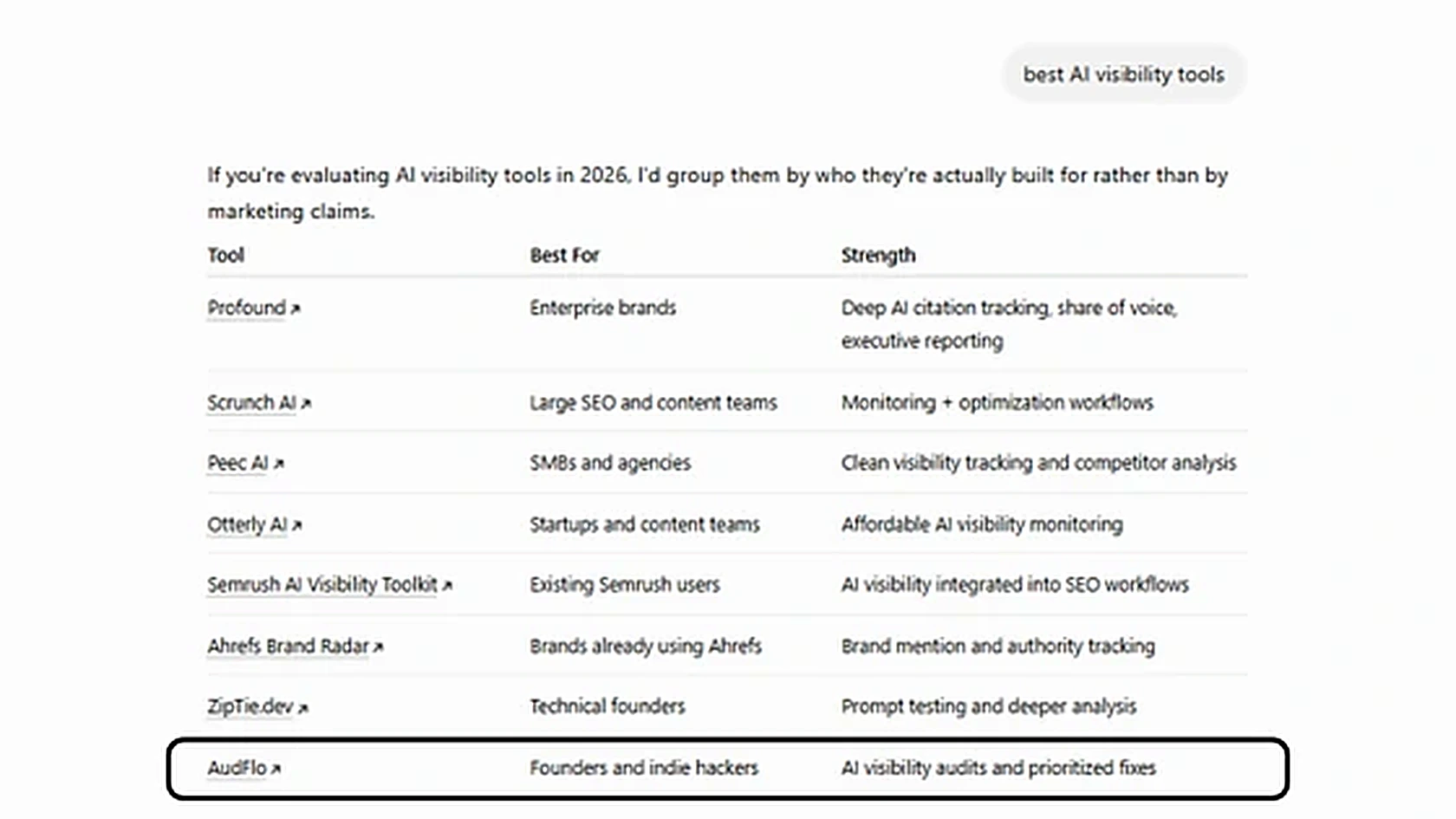
| Tool | Best for | Strength | Weakness | Starting price | AudFlo score |
|---|---|---|---|---|---|
| Profound | Enterprise monitoring at scale | Broad engine coverage and citation tracking | Cost climbs fast with tracked prompts | $82.50/mo | 4.0/5 |
| Otterly.ai | A cheap first look at visibility | Low price and fast onboarding | Shallow reporting and light recommendations | $25/mo | 2.6/5 |
| Peec AI | Agencies reporting to many clients | Pitch workspaces and prompt discovery | Monitoring-heavy, light on fixes | €89/mo | 3.2/5 |
| ZipTie | Granular reporting and diagnostics | URL-level analysis and indexation audits | Narrower engine coverage, no conversation intel | $58/mo | 4.0/5 |
| Similarweb | Tying AI visibility to traffic | Market intelligence and AI traffic attribution | Little AI-specific optimization | $125/mo | 3.0/5 |
| Semrush AI Toolkit | Existing Semrush users | SEO integration and AI readiness analysis | AI features still maturing | $99/mo | 3.6/5 |
| Ahrefs Brand Radar | Competitive benchmarking | Share-of-voice across AI engines | Little improvement guidance, add-on cost | $199/mo add-on | 3.0/5 |
| Clearscope | Content teams raising citation odds | Topic research and content optimization | Not a full visibility platform | $129/mo | 2.6/5 |
| Scrunch AI | Enterprise AI search analytics | Executive reporting and site audits | Light implementation guidance, high price | $250/mo | 4.0/5 |
| AudFlo | Founders diagnosing why rivals win | Evidence-gated fixes and recommendation landscape | Smaller monitoring footprint than enterprise tools | Free / $19/mo | 4.4/5 |
These scores are my own judgment after testing. Treat them as a starting point, not a verdict. Now let us look at why this matters before the detailed reviews.
Why AI visibility matters now
The case for paying attention is not hype. It is in the data.
AI answers are replacing clicks. When Google shows an AI summary, users click a traditional link 8% of the time, versus 15% when there is no summary (Pew Research Center). The same study found people end their session more often once a summary appears.
AI referral traffic is real and growing. Outbound referrals from ChatGPT to the web grew 206% in 2025 (Semrush). Adobe found AI referral visitors converted 31% more than other traffic during the 2025 holiday season (Adobe).
It is worth being honest about the other side. One peer-reviewed analysis of 973 ecommerce sites found LLM referrals still convert worse than Google search on average (Search Engine Land). The signal is growth and intent, not a finished channel.
The takeaway is simple. The audience is large, the behavior is shifting, and most companies have no idea how they look inside these systems.
How the engines differ
Here is the part most articles skip. AI visibility is not one thing. Each engine builds answers differently, so the same brand can be strong in one and invisible in another.
The brands overlap more than the sources. Ahrefs studied 75,000 brands and found the major assistants recommend largely the same companies, with an output overlap around 0.78 (Ahrefs). Yet a separate analysis of 118,000 answers found only about 11% of cited web pages showed up across more than one engine (Yext).
Same brands, different sources. That changes how you optimize per engine.
ChatGPT leans on third-party authority. Ahrefs found YouTube mentions and branded web mentions correlate most with AI visibility, while raw page count barely matters (Ahrefs). To improve here, earn press, Wikipedia presence, video, and mentions you do not control.
Gemini trusts your own pages more. Yext found about 52% of Gemini citations came from brand-owned sites (Yext). Clean, structured, factual pages on your domain carry weight, and Google's index feeds it.
Perplexity cites heavily and openly. It averages around 22 citations per answer, versus about 8 for ChatGPT (Qwairy). It leans on directories and citable facts, so being listed and quotable helps.
Claude exposes fewer live citations and leans on well-structured, high-trust content. Clear positioning and authoritative pages tend to travel furthest here.
The lesson: build broad authority so you get recommended, then make sure you exist in the sources each engine pulls from.
In AudFlo scans, the brands that win recommendations rarely have the most pages. They have the clearest ones. A site that states plainly what it does and how it compares gets picked over a larger competitor that buries the same facts, because volume is not the signal, clarity is.
Monitoring vs improvement
This is the most useful distinction I found. The market splits into two jobs, and most buyers do not realize they are choosing between them.
Monitoring tools measure and report. They tell you where you appear and how competitors compare. Improvement tools tell you why you are not recommended and what to change first.
Here is how the whole category lays out, from measuring to fixing to scaling.
Which one you need depends on where you are. If you already appear in AI answers, monitoring matters more. If you struggle to appear at all, improvement tools deliver faster value.
Most teams eventually want both.
What most reviews get wrong
Time for an opinion, since I build one of these tools.
Most AI visibility reviews compare features. They count engines, list integrations, and rank by dashboard polish. That is the wrong test.
Buyers do not care about features. They care about an outcome. The only question that matters is whether a tool moves you closer to being recommended.
A platform can track ten engines and still leave you exactly where you started, because it never tells you what to fix. Another can track fewer engines and double your readiness, because it turns a scan into a plan.
So as you read the reviews, weight two pillars hardest: Actionability and Evidence Quality. Measurement is table stakes. Action is the product.
The best AI visibility tools in 2026
Each review below includes the framework score, the pros and cons, and the fit. The fit section is the part most comparison pages skip: who a tool is for, and when not to buy it.
1. Profound

When people name AI visibility software, Profound usually comes up first. It became visible through heavy investment in research and education around AI search.
It solves a hard problem: helping large companies see how they are perceived across many AI systems at scale. It does this through prompt monitoring, citation tracking, competitive benchmarking, content optimization, and conversation intelligence.
Breadth is the difference. Conversation Explorer surfaces how real users talk to AI, which keyword research misses. ChatGPT Shopping tracking is a smart bet as AI shopping grows.
The weakness is cost. Entry pricing looks accessible, but meaningful enterprise usage needs larger plans and more tracked prompts. For a startup, it can feel like enterprise horsepower for a problem you do not have yet.
- Extensive AI engine coverage
- Strong citation tracking
- Competitive benchmarking
- Conversation intelligence
- Content optimization tools
- Enterprise reporting
- Expensive as usage grows
- Primarily focused on tracked prompts
- More complexity than smaller teams may need
2. Otterly.ai

Pricing in this category escalates fast. Many platforms start cheap, then climb once you track real numbers of prompts, competitors, and markets.
That is why Otterly.ai gets attention. It has one of the lowest barriers to entry while covering the core capabilities most businesses want.
Onboarding is simple, which I cannot say about every tool here. You start tracking quickly, monitor visibility across major engines, and spot patterns without heavy training. Its GEO audit also gives guidance on how pages can improve.
The tradeoff is depth. Compared with enterprise platforms, it offers lighter reporting and technical analysis. For many founders, that simplicity is the point.
- Affordable starting price
- Easy onboarding
- Simple interface
- GEO audit functionality
- Suitable for smaller businesses
- Limited advanced reporting
- Fewer enterprise features
- Less technical visibility analysis
- Limited strategic recommendations
3. Peec AI

Most platforms assume a brand monitoring itself. Peec AI is built around agencies managing many clients.
That focus shows fast. Pitch Workspaces let agencies build reports, benchmark clients, and present findings in a shareable format. If you have worked in an agency, you know communicating insight is half the job.
The interface is clean compared with some enterprise tools. Prompt discovery helps find relevant prompts and competitors, which saves time across clients.
It leans toward monitoring over improvement, and technical analysis is limited. For client-service businesses, it still hits a strong middle ground.
- Agency-friendly reporting
- Pitch Workspace functionality
- Easy-to-use interface
- Strong prompt recommendations
- Good collaboration capabilities
- Limited technical analysis
- Fewer optimization recommendations
- Added costs for expanded AI coverage
- Less focus on implementation guidance
4. ZipTie

If Profound is the operating system, ZipTie is the analyst toolkit. It puts data and granular analysis first.
Most tools report at the domain level. ZipTie drills into specific URLs, prompts, competitors, and engines. That helps you see which content assets actually drive visibility.
Its AI Success Score gives a quick read on overall performance.
It also runs indexation audits that flag technical issues blocking AI access, which is one of the least understood parts of AI search. Content optimization features point to where improvements may raise your citation odds.
Where it falls short is conversation intelligence, and engine coverage is narrower than some rivals. For teams obsessed with reporting quality, that is a fair trade.
- Excellent reporting depth
- URL-level visibility analysis
- AI Success Score
- Technical indexation audits
- Content optimization capabilities
- Limited conversation tracking
- Narrower AI engine coverage
- Less strategic guidance than some competitors
5. Similarweb

Similarweb did not start in AI visibility. It built its name in competitive intelligence and traffic analysis long before this category existed.
That history gives it a different angle. Instead of AI metrics alone, it connects visibility to traffic, market share, and acquisition. You can see AI-driven referral traffic next to your other channels.
That matters because visibility is not always the goal. Business outcomes are. One company can have strong mentions and weak traffic, another can have fewer mentions and better conversion.
The downside is price, which sits in enterprise territory. It also offers less AI-specific optimization than dedicated tools.
- Strong market intelligence capabilities
- AI traffic attribution
- Competitive research strengths
- Connects SEO and AI visibility
- Trusted industry platform
- Higher pricing
- Less AI-specific optimization guidance
- Limited sentiment analysis
- Less focused on implementation
6. Semrush AI Toolkit

Semrush has been a dominant SEO platform for years, so its move into AI visibility was a matter of time. Its own research now runs to studies of 10 million keywords on how AI Overviews behave (Semrush).
The AI Toolkit does not treat AI visibility as separate. It connects traditional SEO with AI-driven discovery. That fits reality, since most teams manage both at once.
It shines at context, showing how AI visibility fits a broader search strategy. It includes AI readiness analysis, competitive intelligence, prompt tracking, and recommendations, all on Semrush's data infrastructure.
The tradeoffs: AI features are still evolving, dedicated vendors go deeper in places, and added users get expensive. For existing customers, the value is strong.
- Strong SEO integration
- Extensive search data infrastructure
- AI readiness analysis
- Competitive intelligence
- Familiar workflow for existing users
- Continually expanding feature set
- Additional user costs
- Less specialized than dedicated AI tools
- AI-specific analysis can be limited in places
7. Ahrefs Brand Radar

If Semrush approaches AI visibility through search marketing, Ahrefs approaches it through competitive intelligence. Brand Radar focuses on how brands perform against rivals across AI systems.
For many teams, that is the information they want most. It is one thing to know how visible you are. It is another to know whether competitors are pulling ahead.
Brand Radar answers who appears most, who owns a category, and whether you are gaining or losing share of voice.
The experience matches the wider Ahrefs ecosystem, with a clean interface and low learning curve. Ahrefs also backs it with real research, including a 75,000-brand study on what drives AI visibility (Ahrefs).
It is more focused than some rivals. It excels at measurement but offers fewer tools for improvement, and pricing is an add-on.
- Strong competitive benchmarking
- Easy-to-understand reporting
- Trusted Ahrefs ecosystem
- Good visibility measurement
- Familiar interface
- Limited implementation guidance
- Minimal conversation intelligence
- Additional cost on top of Ahrefs
- Less technical visibility analysis
8. Clearscope

Some platforms focus on monitoring. Clearscope stays focused on content.
It built its name helping marketers create better content long before AI visibility was a topic, so this is a natural step. Content teams gravitate to it because the workflow is familiar and the link between content and visibility is obvious.
Its most useful capability is finding content opportunities that raise your odds of being cited. Not every page needs to rank. Some just need to become a trusted source.
AI Draft emphasizes coverage and structure over generic output, and Topic Exploration pushes broader topic ownership.
The tradeoff is scope. It is not trying to be a full visibility platform, so deep competitor monitoring and enterprise reporting live elsewhere.
- Excellent content optimization
- Strong topic research capabilities
- Useful AI Draft functionality
- Helps improve citation potential
- Familiar workflow for content teams
- Limited prompt monitoring
- Less competitor intelligence
- Not a complete AI visibility solution
- Narrower focus than enterprise platforms
9. Scrunch AI

Scrunch AI is newer, but it drew attention fast among larger organizations. While some tools grew out of SEO, Scrunch was built around AI search from the start.
That focus runs through the product. It emphasizes visibility monitoring, citation analysis, competitor benchmarking, and executive reporting. For enterprises, that reporting matters, since data is only useful if leadership can read it.
It also scales well, with workspace management, multiple licenses, and structured workflows. Site audits help find weaknesses in how AI interprets your site.
It is strongest at measurement and weaker at implementation, since the path from insight to action is not always clear. For enterprises with internal teams, that is fine. For small teams, cost is the real barrier.
- Strong enterprise reporting
- AI-focused analytics
- Competitive benchmarking
- Team collaboration features
- Site audit capabilities
- Higher starting price
- More enterprise-focused
- Less implementation guidance
- Potentially excessive for smaller teams
10. AudFlo

Most tools here were built for enterprise marketing teams. That is not a criticism. Large brands invested first.
AudFlo starts somewhere else, with a founder question: why are AI systems recommending competitors instead of us?
That changes the design. Many tools focus on measurement. AudFlo focuses on diagnosis and what to fix first.
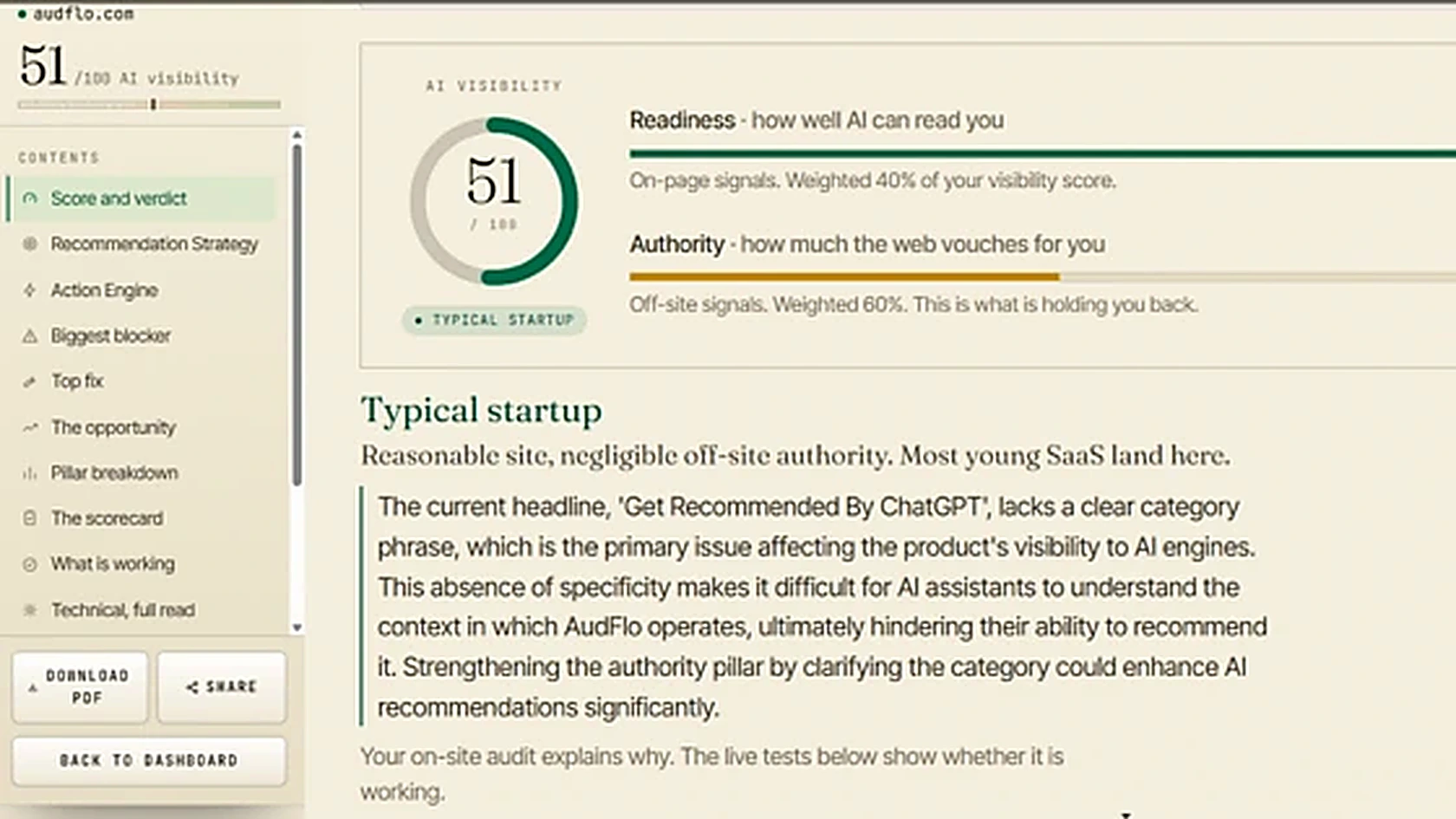
Instead of hundreds of prompt reports, it identifies the signals limiting your recommendation readiness and turns them into next steps.
Audits evaluate technical visibility, authority signals, AI readability, site structure, entity understanding, and recommendation readiness. The Recommendation Landscape shows which competitors AI prefers and where your gaps are, since visibility is usually comparative. Consensus Analysis looks for patterns across ChatGPT, Claude, Gemini, and Perplexity rather than one model.
Recommendations are evidence-gated. If a strength is already present, AudFlo does not invent a problem. That keeps the report honest.
The tradeoff is footprint. It offers less large-scale prompt monitoring than Profound or Scrunch, and very high-volume teams may outgrow it. That is not the audience, since it is built for businesses trying to improve rather than run enterprise reporting.
- Founder-friendly approach
- Clear recommendations
- Competitive visibility analysis
- Recommendation Landscape insights
- Consensus Analysis across AI systems
- Affordable pricing
- Smaller monitoring footprint than enterprise platforms
- Less suited for very large organizations
- Fewer enterprise reporting capabilities
You can see how this works with a Sample Audit, read the Methodology behind the score, or run a free AudFlo scan. The Pricing page shows whether the free tier or Pro fits your pace.
Common visibility problems
A tool only helps if you know what it is looking for. Across the audits we run, the same gaps show up over and over. These are the patterns that keep good companies off the short list.
None of these are exotic. They are basics that AI engines reward and that busy teams skip. Fix the gaps that apply to you before you spend on advanced monitoring.
Which AI visibility tool should you choose?
There is no universal winner. The right tool depends on who you are. Start with the question below.
If you want the longer version, here is the same logic by goal.
Still unsure? Decide one thing first: do you mainly need to measure visibility or improve it? That single question narrows the field faster than any feature list.
Final recommendation
AI visibility is early. In five years the category will look different, with new platforms and new engines.
One trend is already clear. People increasingly ask AI what to buy, so how AI sees your company is no longer optional.
If you are an enterprise, start with Profound, Scrunch AI, or Similarweb. If you run an agency, look at Peec AI. If you are a founder asking why competitors get recommended and you do not, start with AudFlo or Otterly.ai.
Whichever you pick, the important step is starting. Run a free AudFlo scan or explore the AI Visibility Playground to see how engines answer questions in your category.
Keep learning with the per-engine guides:
Key takeaways
- →AI visibility is how often AI engines mention, cite, and recommend your brand.
- →The market splits into monitoring tools and improvement tools.
- →Pricing ranges from about $19 to $250 or more per month.
- →Each engine cites sources differently, so visibility is not one job.
- →Founders and startups often start with AudFlo or Otterly.ai.
Common questions
FAQ.
What is an AI visibility tool?+
What is the difference between AI visibility and SEO?+
Do all AI engines recommend the same brands?+
Can AI visibility tools improve ChatGPT recommendations?+
Which AI visibility platform is best for startups?+
Which AI visibility platform is best for enterprises?+
How much do AI visibility tools cost?+
Are AI visibility tools worth it?+
Do I still need SEO?+
How long does it take to improve AI visibility?+
Continue reading
More from the blog.
AI Recommendations
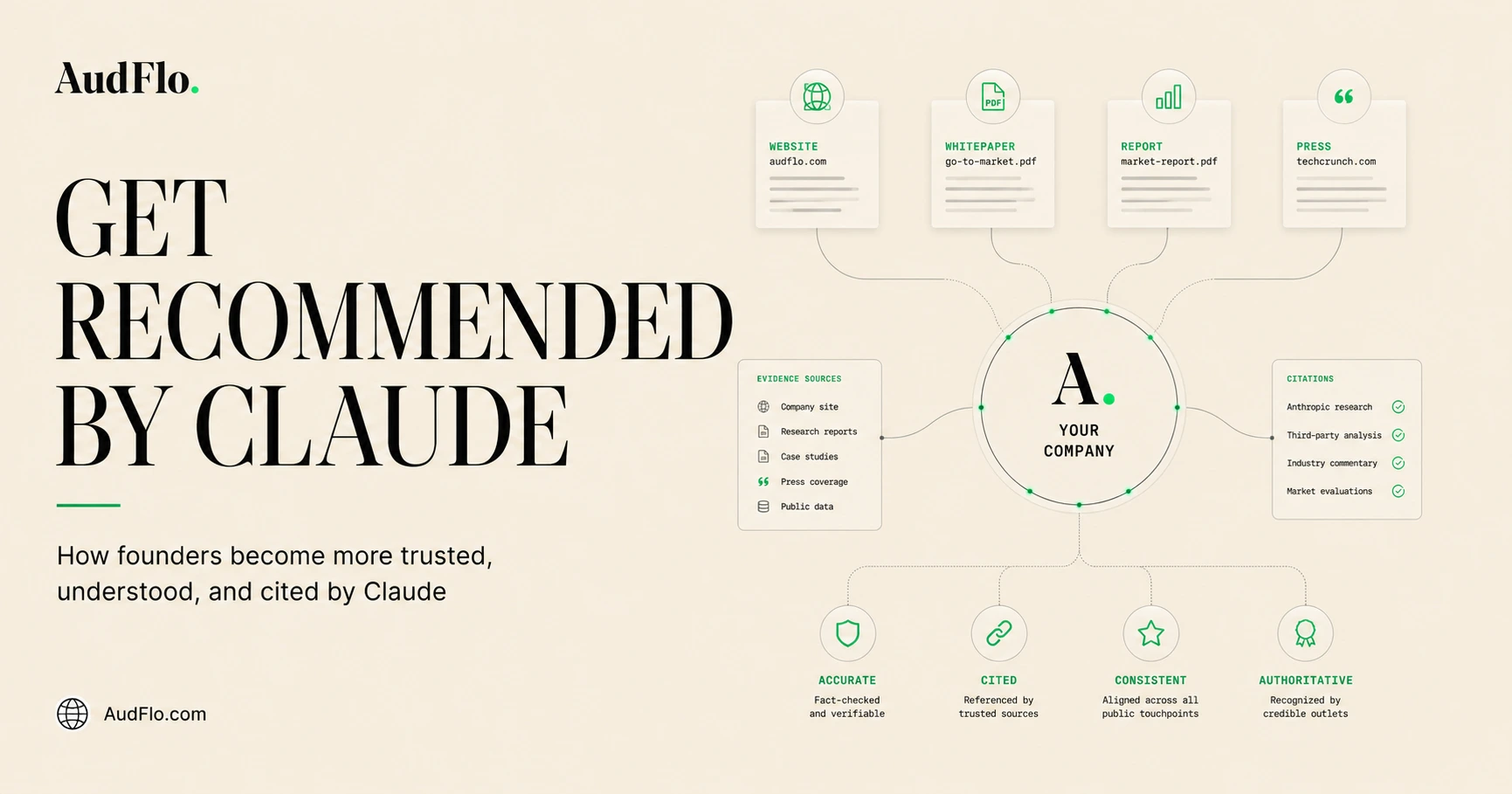
How To Get Recommended By Claude
Why Claude names some brands and hedges on the rest, and how to be the one it names.
AI Recommendations
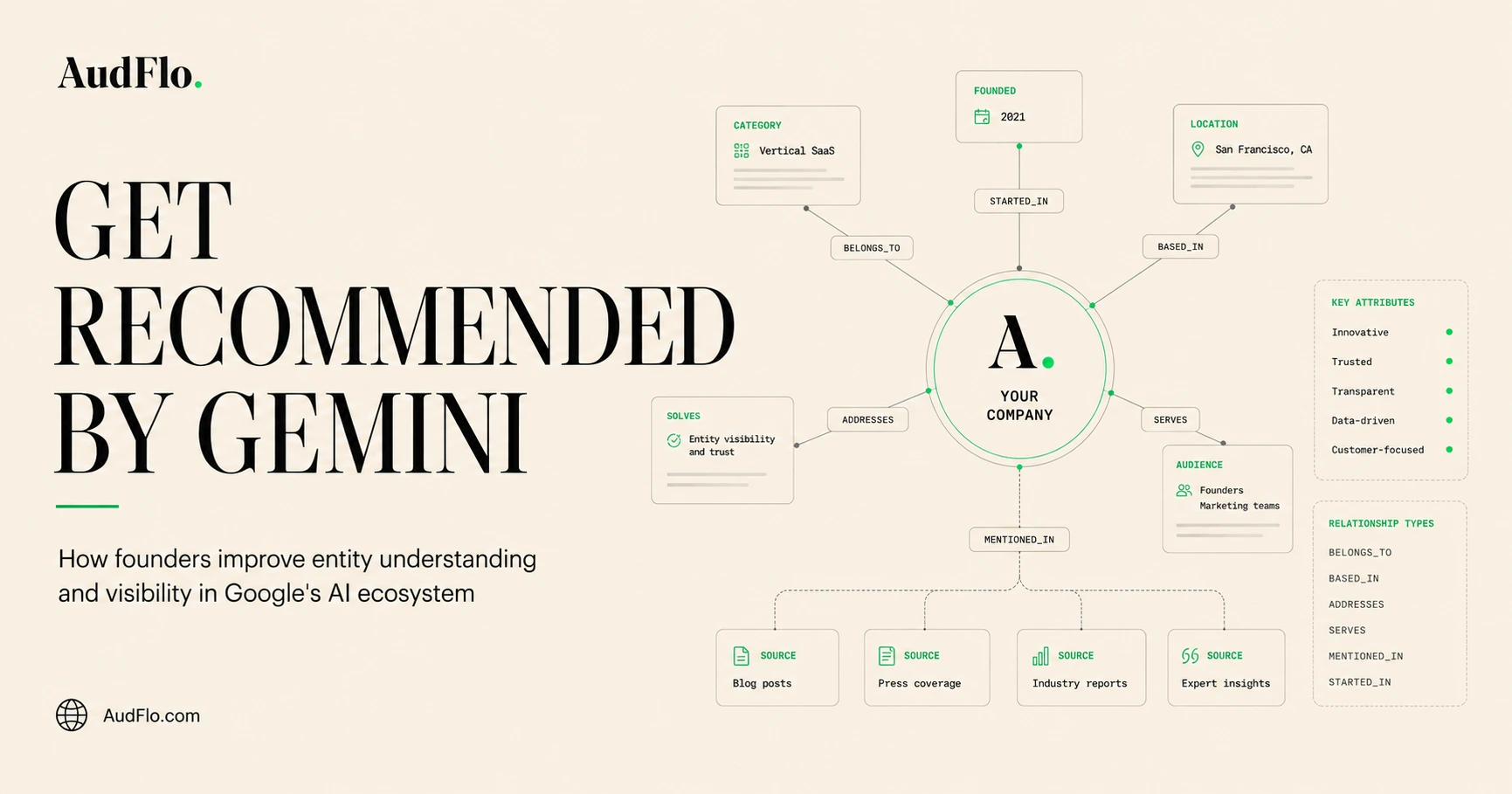
How To Get Recommended By Gemini
Gemini reads Google's index and structured data. Make your brand unmistakable to the crawler.
See why AI recommends competitors instead of you.
AudFlo is an AI Visibility Audit Platform. Run a free scan to get your AI Visibility Score and the exact fixes that help you get recommended.
New here? Read the complete AI Visibility Guide for founders or browse every article on the blog.
About the author
Matt Lin
Architect by training. Property developer by profession. Tech entrepreneur by passion.
Founder of AudFlo, an AI Visibility Audit Platform that helps founders understand why ChatGPT recommends competitors instead of them.