
AI Recommendations
How To Get Recommended By Perplexity
Turn your site into a quotable source Perplexity can trust.
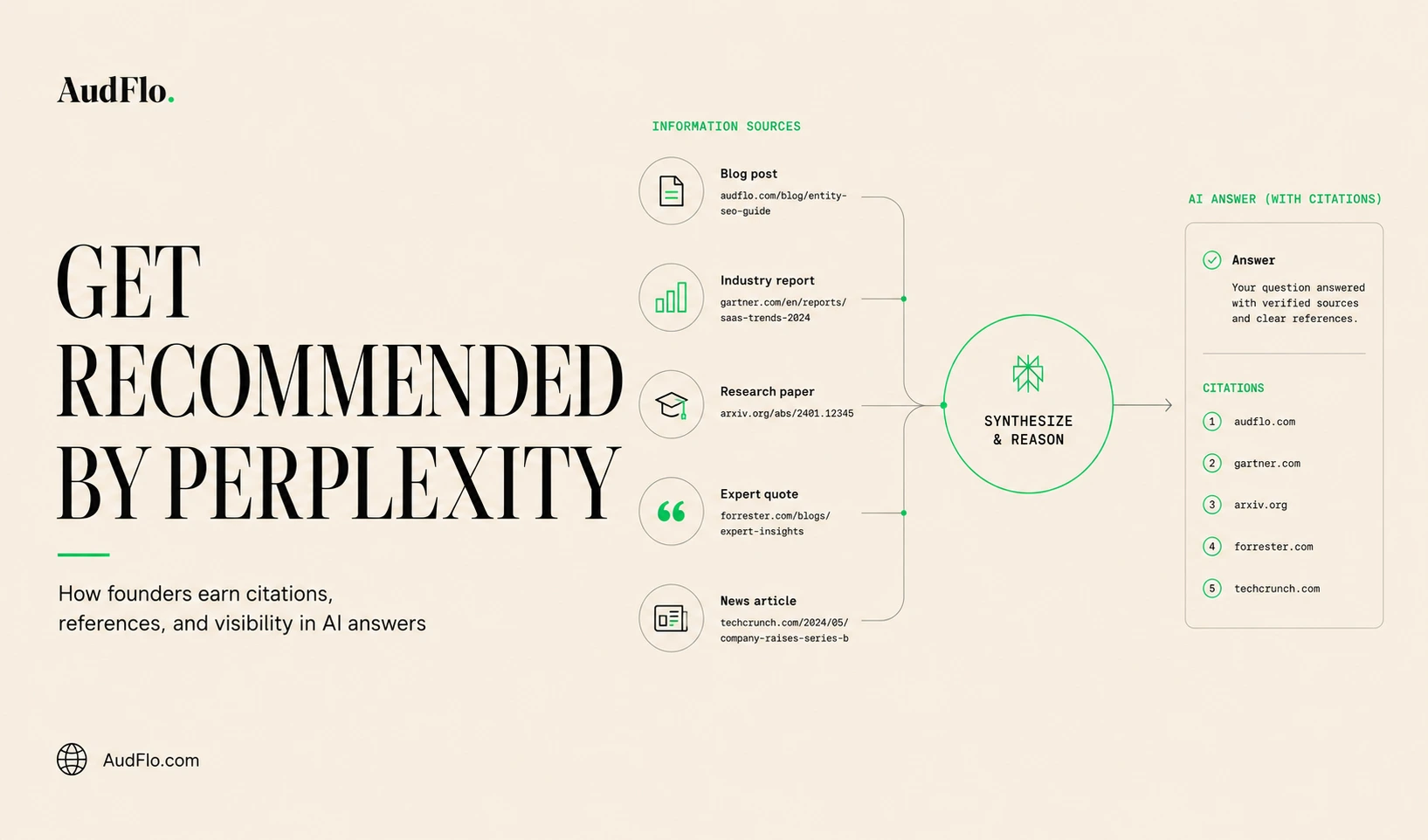
Perplexity cites what it retrieves. Quotable answers and specific claims earn the citation.
Quick answer
Perplexity is an answer engine that builds each reply from live sources it can quote in the sidebar. Your job is to publish pages that look like safe, high quality citations in your category. That means writing clear, self contained answers, backing claims with proof, and making it easy for Perplexity to reach and parse your content. When those pieces line up, your pages become the kind of source Perplexity is comfortable citing, recommending, and revisiting in follow up questions.
The short version
Perplexity is a citation first answer engine that uses the web as a live knowledge base. It searches, selects sources, and then builds natural language answers supported by those sources. The links in the sidebar are not an afterthought, they are the foundation of the product.
Your job is to become one of those default sources in your category. You do that by publishing pages that are easy to quote, easy to verify, and easy to reach. If a page already reads like a safe, well grounded answer to a question your buyers ask, Perplexity has a strong reason to cite it when that question shows up in a prompt.
What Perplexity rewards
Perplexity rewards three specific ingredients. It favors quotable answers that can be lifted almost as is. It prefers specific, checkable claims that users can verify without guesswork.
It also benefits from reachable, structured pages that crawlers and models can understand with minimal friction. Each of these ingredients is under your control as a founder. The rest of this guide walks through the three signals in detail, plus a practical loop you can follow to earn more recommendations over time.
Quotable answers
Perplexity does not want to spend extra effort rewriting your copy into something usable. It wants to find blocks of text that already sound like helpful, direct answers to real questions. If your sections are vague, fluffy, or buried in layout elements, they are harder to lift.
A quotable answer looks like this inside a page. A clear question heading in plain language, such as "What is AI visibility for founders."
A short paragraph just below explains the core concept in two or three sentences, using concrete terms that match the words your users would actually say. A follow up paragraph or two can expand on the idea, but the first block should already stand alone as a self contained answer.
When you build your key pages, think of each H2 as a search or Perplexity prompt that someone would type. Then think of the first paragraph under that H2 as the answer Perplexity would be happy to show, with your domain and brand next to it. If the text does not feel like an answer, rewrite it until it does.
This pattern is not limited to educational content. It also applies to your homepage, feature pages, and comparison pages. For example, on a comparison page, the question might be "How does AudFlo compare to traditional SEO suites."
The first paragraph should plainly state who each tool is for and what problem each tool solves better, without hiding behind slogans. That is the kind of sentence Perplexity can quote when a user asks how tools compare.
Specific, checkable claims
Perplexity is trying to avoid overconfident statements that do not match reality. It wants claims that are grounded in facts, numbers, or patterns it can see across the web. Vague marketing language or unverified superlatives are less attractive as citation material.
Specific claims include numbers, time frames, processes, and concrete outcomes. For example, saying "We cut average onboarding from six steps to two, and 400 teams switched in 2025" is more useful than saying "Our product is very easy to use." The first version gives structure and detail that a user can evaluate, and that other posts can repeat.
You also want claims that users can verify in one or two steps. If you state that your tool helps brands get cited by AI engines, show case studies, sample audits, or screenshots inside your site that back that up. When other blogs, directories, or customers describe your tool, they should echo similar numbers and outcomes.
Avoid claims that Perplexity cannot confirm. Phrases like "best in the world," "guaranteed visibility," or "instant results" are hard to prove, and they do not match how answer engines want to talk about software. Focus on concrete benefits such as faster audits, clearer explanations, more visible answer blocks, and simpler workflows for founders who want AI citations.
When in doubt, ask yourself a simple question. If Perplexity quoted this sentence in an answer, would users feel better informed, or would they feel like they are reading an advertisement. If the sentence looks like pure hype, replace it with specific details that stand on their own.
Reachable, structured pages
Even the best copy is useless if Perplexity cannot reach it, parse it, and connect it to a clear entity. Technical basics still matter. The difference is that you are optimizing for answer extraction and entity confidence instead of only rankings and snippets.
Reachable pages are fast enough to load, friendly to crawlers, and not blocked by scripts or aggressive gating. Important content should render in HTML that does not depend on complex client side interactions.
Avoid hiding your best explanations inside carousels, expandable accordions that load late, or images of text. Those patterns create friction for both crawlers and language models.
Structured pages have clear hierarchies. Titles, headings, and subheadings explain what each section is about without forcing a model to guess.
Internal links connect related concepts with simple, descriptive anchor text, not with vague phrases. A navigation that clearly separates product, methodology, pricing, and educational guides helps Perplexity understand the roles of each page.
You can reinforce this structure with schema, but do not treat schema as a magic trick. Focus first on basic elements, such as meaningful title tags, descriptive meta descriptions, obvious H1s, and consistent naming for your product and company.
Then layer in organization schema, product schema, and FAQ schema where it makes sense. The goal is to give Perplexity multiple cues that all point to the same entity and same area of expertise.
How to earn it
You can earn Perplexity recommendations with a small, repeatable loop. Treat it like an ongoing experiment rather than a one time campaign. The loop has four stages: discover, focus, ship, and verify.
First, discover your current state. Use an AI visibility audit tool such as AudFlo to scan your site and surface where answer engines struggle with your content. The output should show you an overall AI Visibility Score, plus specific blockers grouped by AudFlo's four scoring pillars (see the methodology for how the pillars and weights work).
Second, focus on one or two key pages that map directly to high value questions. Typical examples are your homepage, a core feature or use case page, and a definitive guide for your main topic.
On each of those pages, install the patterns described above. Add clear question style headings, write quotable answers, replace vague claims with specific ones, and clean up the structure so that crawlers can see the main content without obstacles.
Third, ship deliberate improvements rather than cosmetic tweaks. That might mean adding a new FAQ section that mirrors actual customer questions, rewriting your hero copy so the problem and audience are explicit, or creating a comparison page that Perplexity can reference when users ask "tool A vs tool B." It might also include publishing a technical page that explains your methodology in enough detail that answer engines and human readers can both follow it.
Fourth, verify the impact in two ways. Rerun your AI visibility scan to see whether the score and pillar level checks improved.
In parallel, go to the AI Visibility Playground or directly into Perplexity and run prompts that represent your ideal customer questions. Watch whether your site now appears in the source list, whether it appears more often than before, and whether the snippets Perplexity quotes map back to the blocks you improved.
This loop is simple but effective. Scan to reveal your gaps, focus on a small number of pages, ship changes that align with how answer engines work, and verify that those changes turn into visibility. If the results are not strong yet, repeat the loop with additional pages or deeper proof assets such as case studies and testimonials.
You can also inspect a Sample Audit before you start working on your own site. A sample gives you a concrete picture of what a finished evaluation looks like, including the structure of the report, the wording of the checks, and the kinds of Fix Pack assets that make a difference.
If you want to understand how the scoring itself works, and why certain signals are weighted more heavily, open the Methodology guide. The benchmark framework behind the score will help you map Perplexity behavior back to technical and content level actions you can take as a founder.
How long it takes
Perplexity does not update in real time, but it also does not move as slowly as traditional SEO in many cases. Technical fixes and clear new answer blocks can start to matter as soon as your pages are crawled again. In practice, this can mean a few days to a couple of weeks for early signals.
The time curve has layers. At the fast end, Perplexity can adjust which sentences it lifts from your content and which pages it chooses as sources once it reprocesses them.
At the slow end, it takes longer to build a consistent picture of your authority in a category, because that picture involves more than your own site. It accounts for how other sites refer to you, how often your brand appears in relevant contexts, and whether your claims line up with what the rest of the web says.
Think of the first month after your changes as the period where you validate that answer patterns are improving. You might see your pages appear for new types of prompts or appear higher in the list of sources.
Over the next two to three months, you can track whether you are becoming a habitual citation for certain core questions. That is the pattern you want to cultivate because it means Perplexity has internalized you as part of the default set of sources for that topic.
The safest approach is to adopt a quarterly rhythm. Each quarter, run a fresh AI visibility audit, check your Perplexity prompts in the Playground, decide which pages to improve, and ship a batch of updates. This cadence respects the time it takes for authority and citations to compound while keeping your content aligned with how answer engines actually behave.
Common mistakes
To avoid these mistakes, pair this guide with the ChatGPT guide. ChatGPT teaches you how to frame entities and instructions so a single assistant feels comfortable talking about your product. Perplexity teaches you how to become a reliable citation in a multi source answer engine.
When you are ready to move from ideas to implementation, run a free AudFlo scan, explore the Methodology that sits behind the AI Visibility Score, and review the Sample Audit to see what a complete pass looks like. If you want to work on this consistently, the Pricing page shows whether the free tier or Pro fits the pace you want to ship improvements at.
Related recommendation guides
Work the same loop across every engine:
Key takeaways
- →Perplexity is citation centric, it looks for pages that are worth quoting, not just ranking.
- →Short, direct answer blocks make it easy for Perplexity to lift and cite your content.
- →Specific claims that users can verify create more confidence than vague marketing language.
- →Fast, reachable, well structured pages remove friction for Perplexity crawlers and models.
- →A simple audit loop, scan, focus, ship, rescan, steadily increases your citation readiness.
Common questions
FAQ.
What is Perplexity and how is it different from traditional search?+
Why does Perplexity care so much about citations?+
What makes a page quotable for Perplexity?+
How is getting recommended by Perplexity different from ranking in SEO?+
How can a small product site compete for Perplexity visibility?+
Does structured data matter for Perplexity recommendations?+
How often should I work on my Perplexity visibility?+
Can one strong page be enough to get cited regularly?+
Do I need to write for Perplexity separately from other engines?+
Where can I see how an AI visibility audit works in practice?+
Continue reading
More from the blog.
AI Recommendations
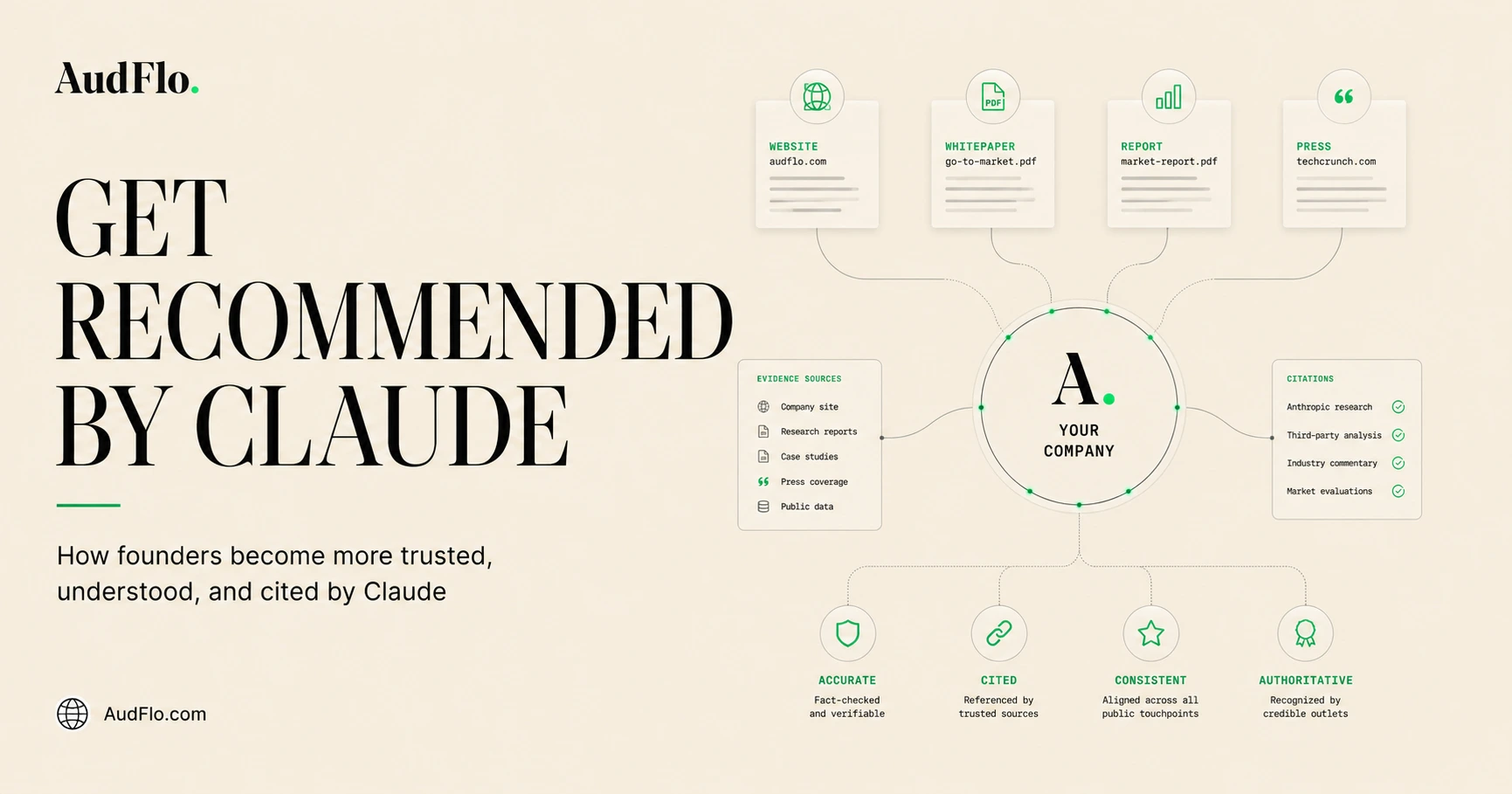
How To Get Recommended By Claude
Why Claude names some brands and hedges on the rest, and how to be the one it names.
AI Recommendations
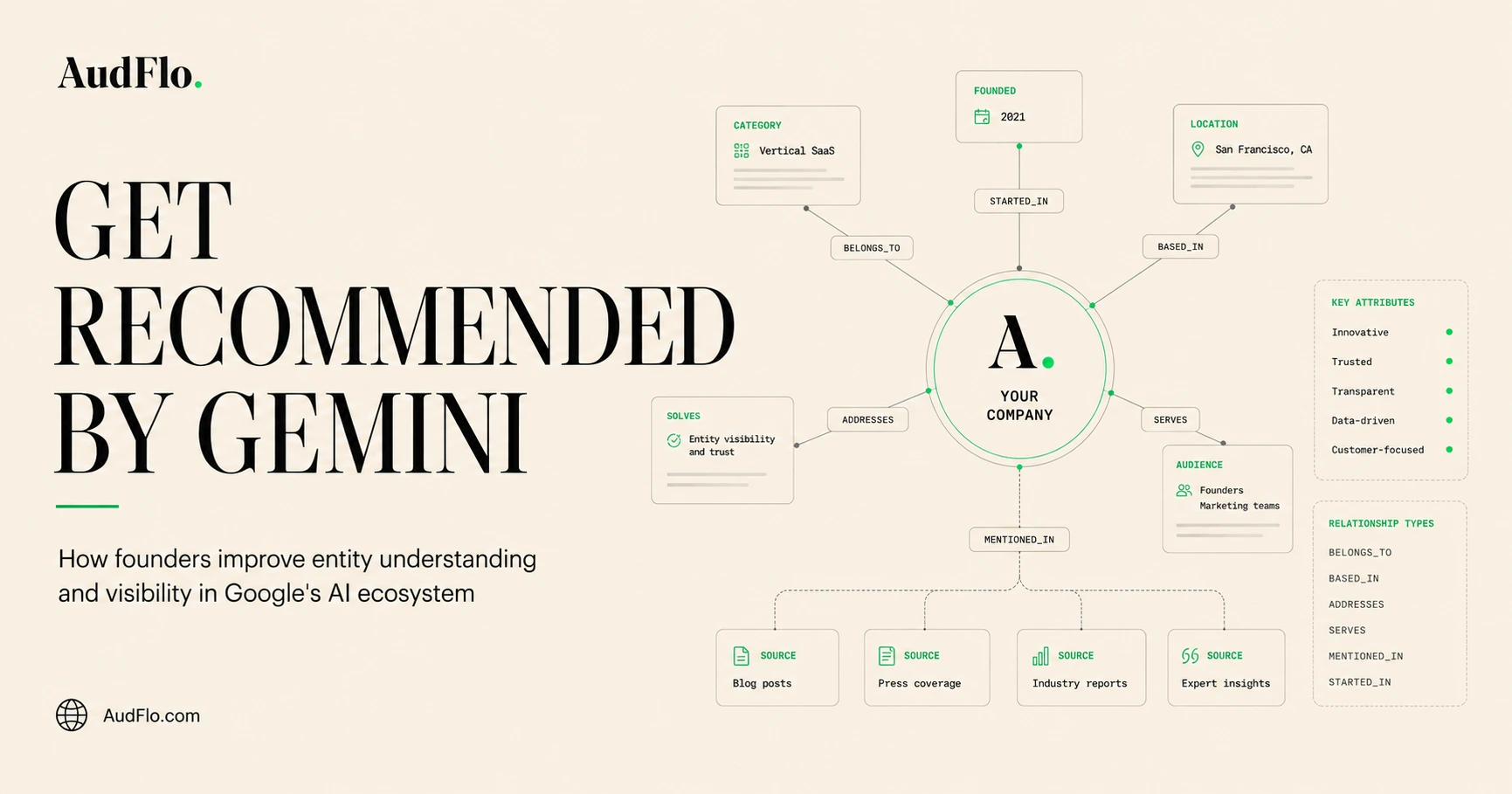
How To Get Recommended By Gemini
Gemini reads Google's index and structured data. Make your brand unmistakable to the crawler.
See why AI recommends competitors instead of you.
AudFlo is an AI Visibility Audit Platform. Run a free scan to get your AI Visibility Score and the exact fixes that help you get recommended.
New here? Read the complete AI Visibility Guide for founders or browse every article on the blog.
About the author
Matt Lin
Architect by training. Property developer by profession. Tech entrepreneur by passion.
Founder of AudFlo, an AI Visibility Audit Platform that helps founders understand why ChatGPT recommends competitors instead of them.