
AI Recommendations
How To Get Recommended By Claude
Why Claude names some brands and hedges on the rest, and how to be the one it names.
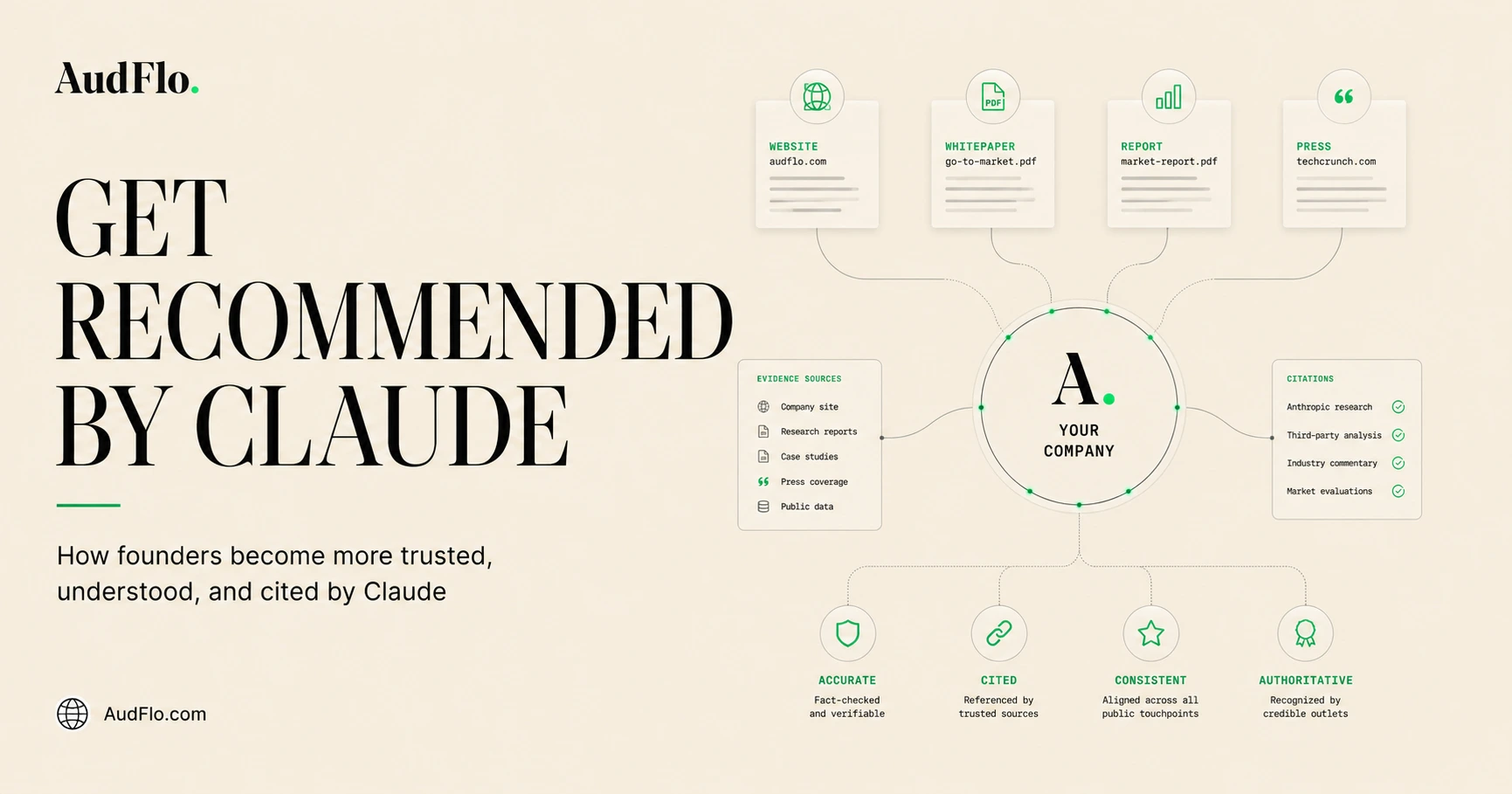
Claude names what it can restate, verify, and follow. Clarity, evidence, and structure earn it.
In this article (6 sections)
Quick answer
Claude recommends brands it can confidently restate, verify, and follow. It is cautious by design, so it favors a clear category line, evidence it can check, and clean page structure over polish or hype. To get recommended, make what you do obvious in plain words, back your claims with named and verifiable proof, and structure your pages so a careful reader can follow them. Then build the third party signals that let Claude trust you beyond your own site.
The short version
Claude is an AI assistant that millions of people now ask for recommendations. When someone asks it for the best tool in a category, it replies with a short list, usually the brands it can describe with confidence. It is cautious by design, so it leans toward what it can verify rather than what merely sounds impressive.
That caution is the whole game. Claude would rather give a careful answer than a confident wrong one, so it quietly drops any brand it cannot explain, trust, and parse. If it cannot confidently say what you are, it picks someone safer and you never see it happen.
Your job is simple to state and harder to do. Make your brand something Claude can restate, verify, and follow. Get those three right and you move from ignored to named.
What Claude weighs
Claude rewards confidence, not volume. It recommends what it can explain without guessing, and it backs off the instant a claim cannot be checked or a page cannot be parsed.
Three signals decide which way it goes, and they compound, so a weakness in one drags the others down. See how the three roll into a single score in the methodology.
Clarity it can restate
Claude recommends what it can paraphrase. Before it names you, it has to be able to say, in its own words, what you do and who you do it for. If it cannot produce that sentence with confidence, it leaves you off the list rather than risk describing you wrong.
So the first test is brutally simple. Could a stranger read your first line and immediately say what you are and who it is for. If the answer is no, Claude is in the same position as that stranger.
Weak category lines hide the product behind a feeling. Phrases like "reimagine your workflow" or "the future of growth" tell a model nothing it can restate. Strong category lines name the thing: what it is, who it serves, what it does, in plain words, before any story or styling.
Placement matters as much as wording. The clear line should appear above the fold, in your H1 and subhead, in your meta description, and in your llms.txt, so every surface a crawler reads tells the same story. A clear line buried on page three does not help, because the model may never reach it.
Consistency across pages is the part most brands miss. If your homepage calls you one thing, your about page calls you another, and your pricing page uses a third phrase, Claude sees a blurry entity and lowers its confidence accordingly. This is what AudFlo measures as entity confidence, and it is the quiet reason many clear looking sites still get skipped.
The fix is to write the category line once and propagate it everywhere. One sentence, one meaning, repeated across the homepage, the about page, the pricing page, the meta tags, and the llms.txt. Sameness here is a feature, not a lack of imagination.
Evidence it can verify
Claude is careful with claims it cannot confirm. It will not stake a recommendation on a boast, because a boast is the kind of thing every brand makes. What moves it is proof a reader could go and check.
Think of evidence as a ladder. At the bottom sit anonymous claims that anyone could write: "the best," "trusted by thousands," "loved by teams everywhere."
At the top sit named, specific, third party proofs that are hard to fake and easy to verify. AudFlo calls this the evidence ladder, and Claude climbs it the same way a skeptical buyer would.
Strong evidence has names attached. A testimonial from a real person with a real role at a named company beats a wall of anonymous five star quotes. A specific number, like cutting onboarding from nine days to two, beats a vague superlative, because the specificity itself signals it came from somewhere real.
A real founder or team page helps more than people expect. It tells Claude a real person stands behind the product, with a name, a face, and a history it can corroborate. Faceless brands are harder to trust, so they are harder to recommend.
The strongest evidence is the kind you do not control. Mentions on sites other than your own, reviews on third party platforms, inclusion in independent roundups, and references in other people's writing all carry more weight than anything on your homepage. The reason is simple: you cannot edit them, so they are believable.
What actively hurts you is unverifiable confidence. Big claims with no source, stats with no citation, and superlatives with no name read as noise at best and as risk at worst. When in doubt, Claude treats an unprovable claim as a reason to choose someone safer.
Structure it can follow
Claude reads structure, not just words. Two pages can contain the same facts, and the one that is organized cleanly will be understood while the other is missed. Structure is how meaning survives the trip from your page into an answer.
Answer-first writing is the single highest leverage habit. Lead each section with the answer in plain language, then explain underneath. A model can lift a clear opening sentence straight into a response, which is exactly what you want.
Your headings should describe function, not perform marketing. "How pricing works" is parseable, while "Unlock your potential" is not, because it tells a model nothing about what the section contains.
Clean, descriptive H2 and H3 headings act as a map a crawler can read. They let Claude move through your page without guessing what each part is for.
Structured data makes the implicit explicit. FAQPage schema turns your questions into something a model can extract with certainty, Organization schema states who you are, and Product schema clarifies what you sell. Schema is not decoration, it is you removing ambiguity on purpose.
An llms.txt file gives crawlers a clean, plain statement of what you do, separate from your design. It will not carry a weak site on its own, but paired with clarity and evidence it removes friction. Treat it as a courtesy to the reader, not a trick.
Rendering is where good content quietly disappears. If your key sections only appear after JavaScript runs, a crawler that reads the raw HTML may see an empty shell where your value proposition should be. Server-render anything that explains what you do, so it exists before a single script fires.
Small things round it out. Descriptive alt text on meaningful images, sensible internal links between related pages, and a logical page order all help a model move through your site without losing the thread. None of these are dramatic on their own, and together they decide whether you are followable.
How to earn it
The loop is the same one that works across every engine. See how you read now, fix the gaps, build authority, then check again. Run it on a cadence rather than once.
- See how Claude reads you now. Run your URL through the Playground to watch an engine parse you in real time, or read a full Sample Audit to see scores, blockers, and fixes for a fictional example company. Start here so you are fixing what is actually wrong, not what you assume is wrong.
- Fix clarity and structure first. Rewrite your category line, propagate it across every page and meta tag, add answer-first sections, clean your headings, add FAQ and Organization schema, and ship an llms.txt. These are on-site, fully in your control, and fast to land.
- Add verifiable evidence. Replace anonymous superlatives with named testimonials, swap vague claims for specific numbers, publish a real founder page, and add case studies as they arrive. Move yourself up the evidence ladder one named proof at a time.
- Build off-site authority, then re-scan. Earn mentions on sites other than your own, get listed where your category gets compared, and publish something genuinely worth citing. Then run the audit again and watch the signals move, because what you cannot measure you cannot improve.
How long it takes
On-site work lands fast. Clarity, structure, and schema fixes become visible to crawlers within a cycle or two, often within days of redeploying. This is the half you fully control, so it is where you should see the first movement.
Expect the early gains to come from clarity. Once your category line is sharp and consistent and your structure is clean, a model can finally restate you, and that alone lifts you out of the ignored bucket. Many brands feel the difference here before they have earned a single backlink.
Off-site authority is slower and less tidy. The third party mentions Claude verifies against take weeks to months, because they depend on other people choosing to reference you. There is no switch for trust, so it accrues rather than flips.
Treat it as compounding, not linear. Each named proof and each independent mention makes the next recommendation a little more likely, and the advantage gets harder for latecomers to catch. The brands that start now are building a lead that quietly widens.
Common mistakes
The same clarity helps across engines, so see the companion ChatGPT guide for where the two differ in practice. When you are ready to automate the audit and generate the fixes, compare plans on Pricing.
Related recommendation guides
Work the same loop across every engine:
Key takeaways
- →Claude recommends what it can restate in one sentence, so lead with a plain category line.
- →It weights verifiable evidence (named testimonials, real numbers, third party mentions) over unprovable superlatives.
- →It reads structure, so answer-first content, clean headings, FAQ schema, and an llms.txt help.
- →Content hidden behind JavaScript may be invisible to it, so server-render what matters.
- →On-site clarity moves fast, while off-site authority is slower because it depends on other people.
Common questions
FAQ.
How do I get Claude to recommend my product?+
Does Claude read my whole site?+
Why does Claude seem cautious about naming products?+
Do mentions on other sites help with Claude?+
How do I know if it is working?+
Continue reading
More from the blog.
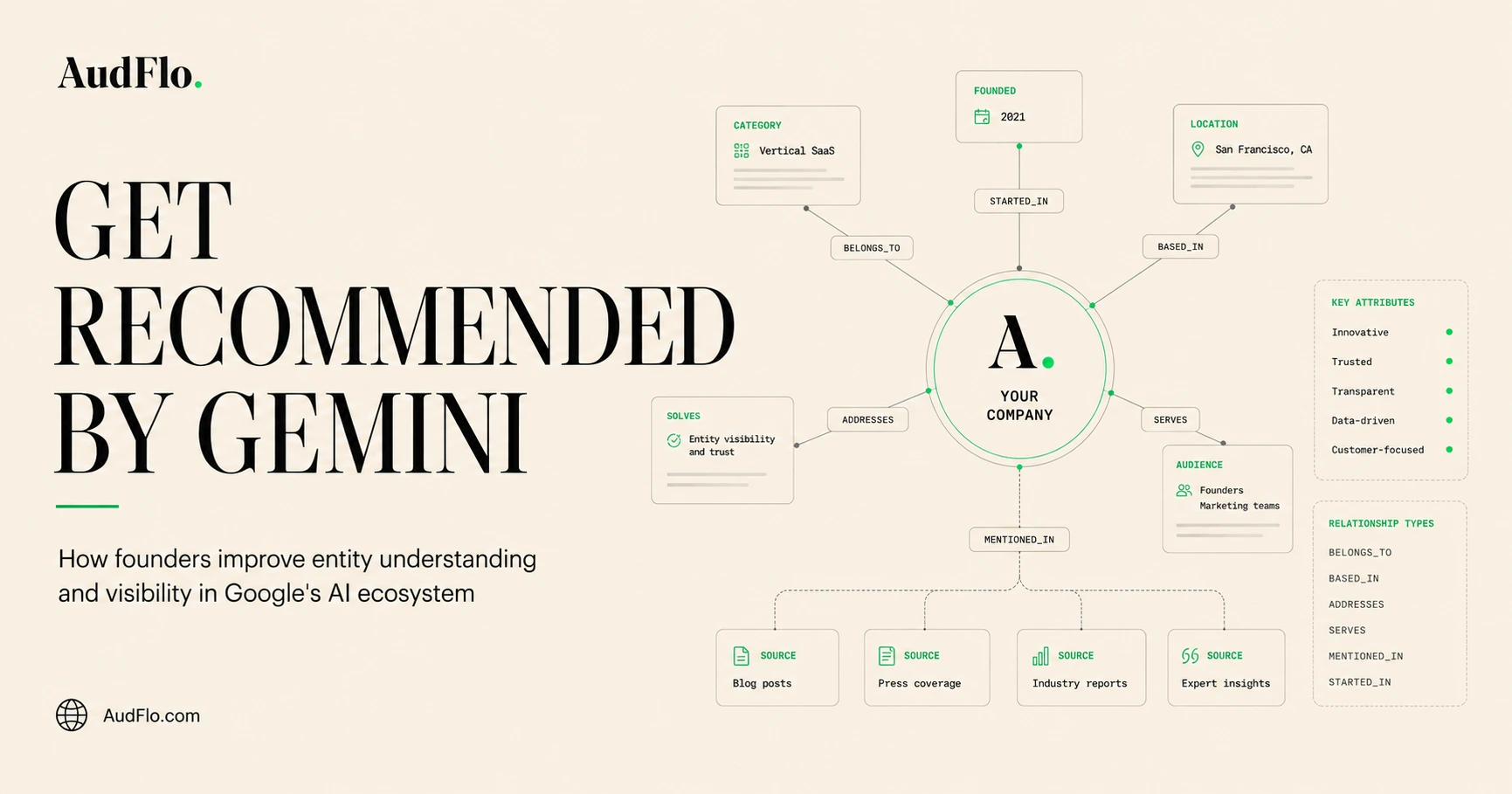
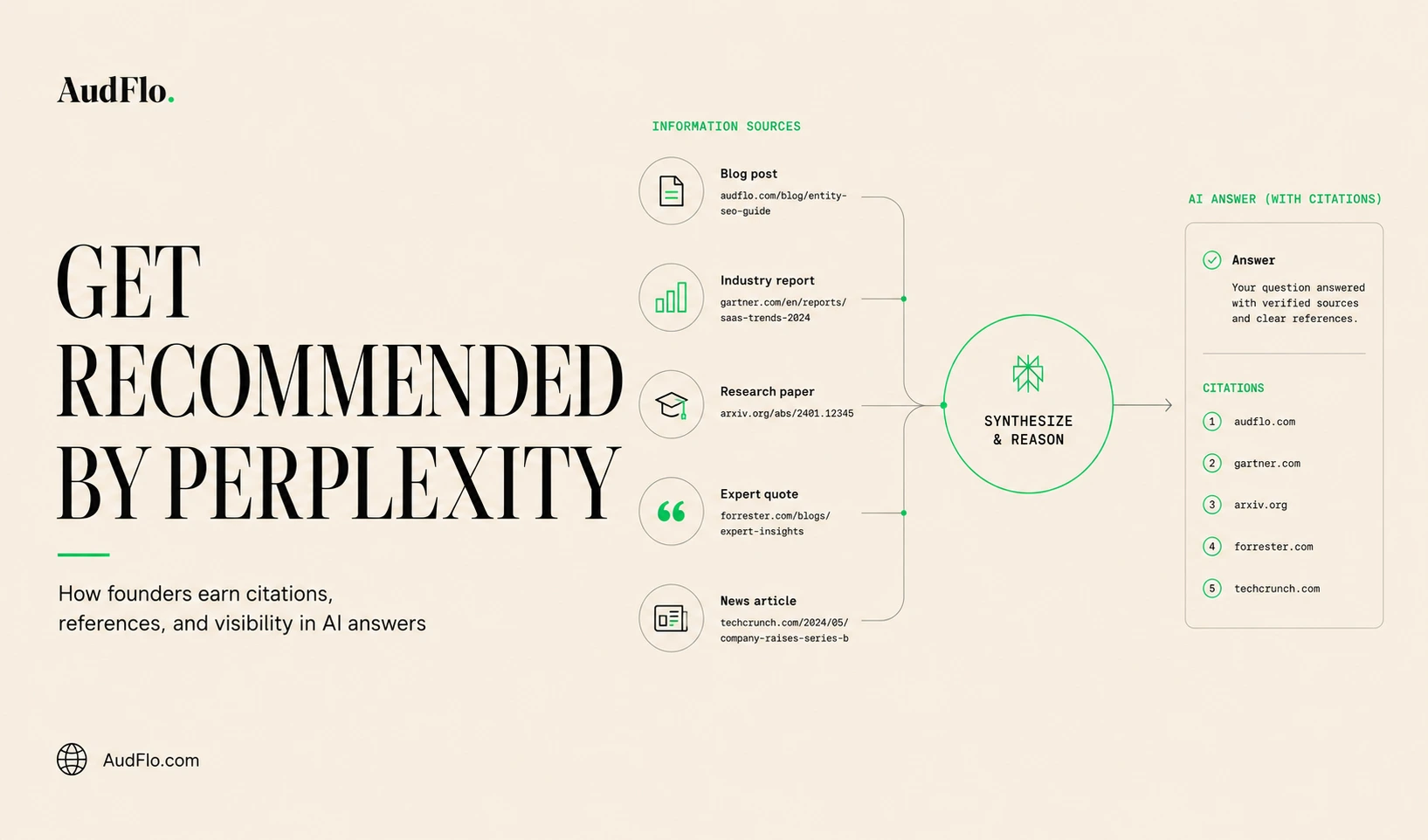
See why AI recommends competitors instead of you.
AudFlo is an AI Visibility Audit Platform. Run a free scan to get your AI Visibility Score and the exact fixes that help you get recommended.
New here? Read the complete AI Visibility Guide for founders or browse every article on the blog.
About the author
Matt Lin
Architect by training. Property developer by profession. Tech entrepreneur by passion.
Founder of AudFlo, an AI Visibility Audit Platform that helps founders understand why ChatGPT recommends competitors instead of them.