
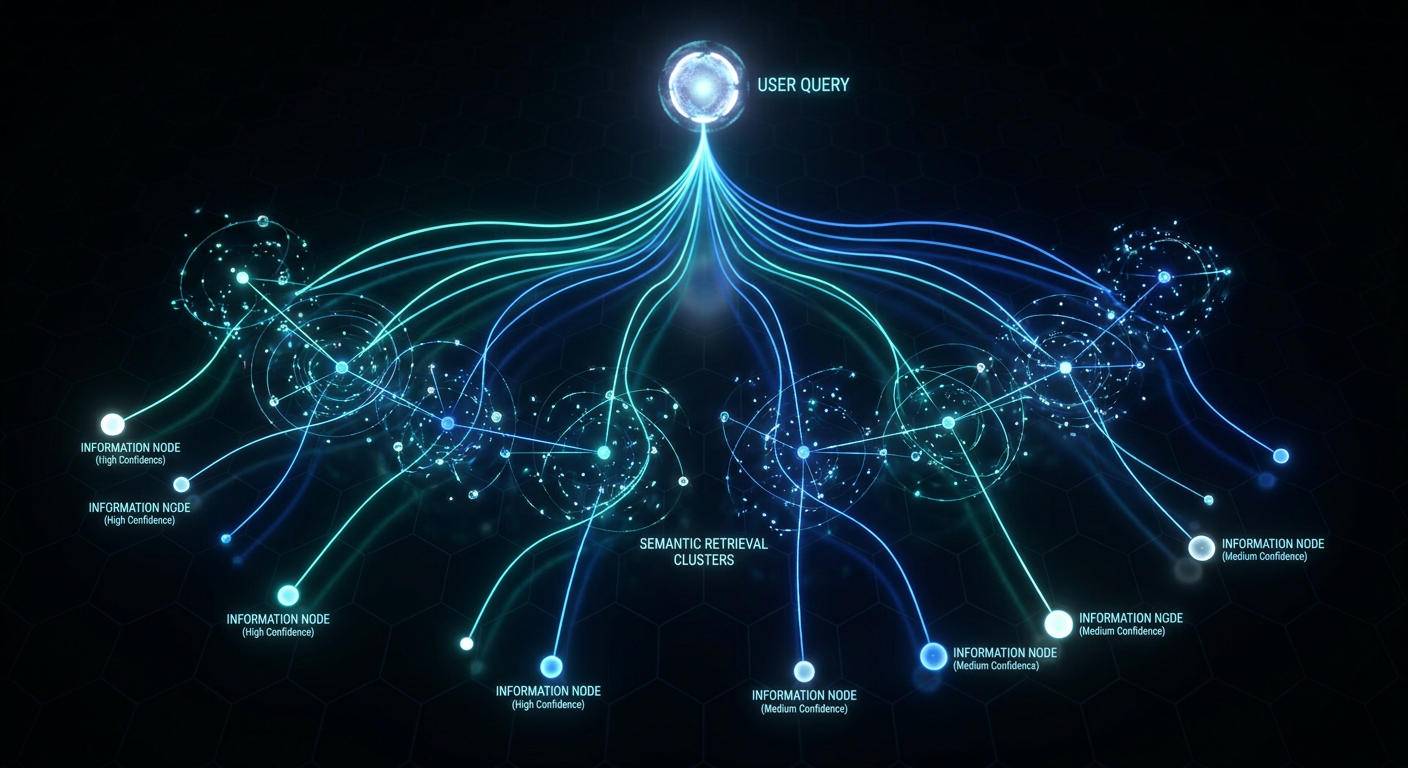
When someone types a question into ChatGPT, Perplexity, or Google AI Overviews, the AI system does not retrieve information using only the exact words in the query. It expands the original question into a network of smaller related searches simultaneously. This process is called query fan out, and it fundamentally changes what discoverability means. Instead of competing for a single keyword, brands now need to be consistently visible across an entire semantic ecosystem of related queries. The brands that win AI search are not the brands with one optimized page. They are the brands present across the full topic graph that AI systems explore when formulating an answer.
Part of the AEO cluster
This article is part of the AI visibility topical authority cluster. For a full introduction to how AI search works and why AEO matters, start with the pillar guide: What Is AEO and Why AI Search Is Changing SEO Forever.
What Is Query Fan Out?
Query fan out is when an AI system expands one user question into many smaller semantic subqueries behind the scenes. Instead of retrieving information from one direct search, the AI creates an entire network of supporting searches simultaneously.
A user might ask: "Best CRM for startups."
But internally, the AI may expand into searches for startup sales software, affordable CRM tools, HubSpot alternatives, CRM for remote teams, founder workflow automation, sales pipeline software, CRM onboarding simplicity, and startup customer management systems.
All of these retrieval paths may influence the final answer. The user never sees these hidden searches. But they heavily shape which brands get surfaced.
This means AI retrieval is no longer driven by isolated keywords alone. It is driven by semantic breadth.
Why AI Search Expands Queries
AI systems expand queries because human questions are often incomplete. People ask broad prompts: best headphones, best AI tools, best CRM, best project management software.
But to generate useful answers, the AI needs context, comparisons, supporting information, subtopics, reviews, semantic relationships, and category understanding. This forces the AI to retrieve information from multiple angles simultaneously.
The result is far richer retrieval behavior than traditional search engines historically used. Instead of matching keywords, AI systems increasingly map intent ecosystems.
What this means for your content strategy
A brand appearing across many semantic branches of a topic is far more retrievable than a brand optimized for a single keyword. Content strategy should be built around topic ecosystems, not isolated pages.
How Query Fan Out Works Behind The Scenes
Modern retrieval systems often operate through layered retrieval pipelines. A simplified version of the process looks like this.
The AI retrieval pipeline (simplified)
- User enters a prompt into the AI interface
- AI interprets the semantic intent behind the prompt
- AI expands the prompt into multiple semantic subqueries
- Retrieval systems gather sources across all subqueries simultaneously
- AI scores source relevance across the full query fan
- AI synthesizes gathered information into a coherent response
- Final response is generated probabilistically from the scored sources
This process happens extremely fast. But the important insight is this: your brand may become visible even if the exact original query never mentions your keyword directly. Retrieval occurs across many supporting semantic branches.
This is why topic coverage matters, semantic relevance matters, ecosystem visibility matters, and entity association matters far more than any single-keyword ranking.
Why Traditional Keyword SEO Is Changing
Traditional SEO heavily focused on exact match keywords, isolated landing pages, ranking positions, keyword density, and singular search intent. AI retrieval changes this dramatically.
AI systems increasingly reward semantic completeness, topic relationships, contextual relevance, entity consistency, and comprehensive topical coverage. Single isolated pages are becoming less powerful on their own.
Traditional SEO vs AI retrieval logic
| Dimension | Traditional SEO | AI retrieval |
|---|---|---|
| Query interpretation | Exact keyword matching | Semantic intent expansion |
| Retrieval unit | Individual ranked page | Topic ecosystem breadth |
| Success metric | Ranking position | Retrieval frequency across subqueries |
| Content strategy | Keyword-per-page optimization | Topical authority clusters |
| Authority signal | Backlinks to the page | Entity consistency across ecosystem |
| Visibility scope | One SERP position | Probabilistic across many retrieval paths |
A page about "Best CRM Software" may struggle if the surrounding ecosystem lacks onboarding content, comparison pages, startup workflows, and implementation guidance. AI systems evaluate topic ecosystems more holistically. This connects directly to why each AI platform retrieves content differently: the breadth of your semantic footprint interacts with platform-specific retrieval logic in different ways.
Why Topical Authority Matters More Than Ever
Query fan out naturally rewards topical authority. If AI systems expand one question into 20 supporting retrieval paths, brands appearing repeatedly across those paths gain stronger retrieval probability.
This creates compounding visibility advantages. A founder building visibility around "AI visibility tools" may strengthen retrieval probability by covering AI citations, retrieval systems, semantic SEO, AI search platforms, topic clustering, entity optimization, AI discoverability, conversational search, and AI ranking systems.
The wider the semantic coverage, the stronger the retrieval ecosystem becomes. This is not a gradual linear improvement. It compounds. Each new supporting piece reinforces the authority of everything else.
Topical authority as a compounding asset
Topical authority built through query fan out coverage compounds over time. Each new article covering a semantic subtopic strengthens retrieval probability for the entire cluster, not just the new page itself.
How AI Systems Build Semantic Understanding
AI systems increasingly operate through entity relationships. They do not simply look for matching words. They evaluate topic proximity, semantic relationships, contextual consistency, repeated associations, and retrieval confidence.
If your brand repeatedly appears near concepts like AI visibility, answer engine optimization, AI retrieval, and AI citations, the system increasingly associates your brand with those concepts. This strengthens future retrieval probability.
Semantic repetition becomes a visibility asset. Consistent topical association across many sources is far more powerful than any single highly optimized page.
This is the core mechanism behind why AI visibility compounds faster than traditional SEO. Each new semantic association strengthens the overall entity confidence the AI system has in your brand.
What Founders Get Wrong About AI Visibility
Optimizing Only One Page
Modern AI retrieval rewards ecosystems, not isolated pages. A single well-ranked page contributes to retrieval probability but represents only one branch in a query fan. Brands with only one strong page are structurally underrepresented across the full semantic retrieval landscape.
Ignoring Supporting Content
Supporting articles strengthen retrieval relevance significantly. A pillar article with no cluster content is like a hub with no spokes. The full topic coverage is what creates ecosystem-level authority that AI systems can retrieve from across many subquery branches.
Thinking Only In Keywords
AI retrieval increasingly prioritizes concepts and semantic relationships over exact keyword matches. Founders who plan content only around keyword volume miss the semantic subtopics that compose the query fan. Those subtopics are often where the retrieval actually happens.
Building Thin Topic Coverage
Thin ecosystems reduce retrieval confidence. When an AI system fans out across a topic and finds only sparse coverage from your brand, the retrieval probability drops. Depth and breadth of coverage together determine how frequently your brand appears across the full query fan.
Ignoring Internal Linking
Internal linking reinforces topic relationships and semantic structure for both AI crawlers and retrieval systems. A content ecosystem without strong internal linking is harder for AI systems to navigate and map as a coherent topic cluster.
How To Build Content For Query Fan Out
Modern content strategy should focus on topic clusters, semantic relationships, supporting content, retrieval depth, and entity reinforcement rather than on isolated keyword pages.
Content ecosystem structure for AI retrieval
- One pillar article covering the core topic with maximum semantic breadth
- Multiple supporting articles covering subtopics and semantic branches
- Comparison pages addressing category-level queries
- FAQ content addressing the specific question formats AI retrieval favors
- Implementation or how-to guides covering practical applications
- Glossary or definition pages for entity disambiguation
- Use case content covering application contexts AI systems retrieve for
- Strong internal linking connecting all cluster pages bidirectionally
Each page in this structure strengthens retrieval relevance for the broader ecosystem. The pillar page benefits from the cluster content, and the cluster content benefits from the pillar page's authority.
Why Topic Clusters Beat Single Pages
Topic clusters mirror how AI systems retrieve information through query fan out. This structural alignment makes them extremely powerful for AI visibility.
A topic cluster reinforces semantic authority, strengthens entity consistency, improves retrieval coverage, expands visibility probability, and increases contextual relevance simultaneously. This is why modern AI visibility strategy increasingly resembles building knowledge ecosystems rather than isolated SEO pages.
The practical implementation starts with an audit. Understanding which topics your brand currently covers, which semantic branches are missing, and where the largest retrieval gaps exist is the foundation of any effective query fan out strategy. An AI visibility audit surfaces exactly these gaps across your current content ecosystem.
The compounding risk of ignoring topic coverage
As AI search becomes more prevalent, brands with thin or isolated content ecosystems face growing retrieval disadvantages. The gap between brands with comprehensive topic coverage and those without widens every month. Starting now has compounding returns.
The Future Belongs To Topic Ecosystems
Query fan out fundamentally changes how search works. Visibility is no longer about one keyword, one ranking, and one page.
Modern AI systems retrieve information across semantic networks. The brands that win are topically deep, semantically broad, consistently associated, contextually reinforced, and repeatedly retrieved.
This is why AI visibility compounds differently from traditional SEO. And it is why understanding the specific retrieval behavior of each AI search platform matters so much. The intersection of query fan out behavior and platform-specific retrieval logic determines where your brand surfaces and how often.
The future of discoverability belongs to topic ecosystems. Not isolated rankings.
FAQ
What is query fan out?
Query fan out is when AI systems expand one user prompt into many semantic subqueries behind the scenes. These subqueries run simultaneously and collectively shape which sources, brands, and content the AI surfaces in its final response.
Why does query fan out matter for SEO?
Query fan out changes how AI retrieval rewards content. Instead of a single keyword match determining visibility, semantic breadth across a topic ecosystem determines retrieval frequency. Brands covering a topic comprehensively appear across far more retrieval paths than brands with isolated pages.
Does query fan out replace keyword optimization?
No. Keywords still matter, but they are no longer sufficient on their own. Semantic coverage across a topic cluster is what drives retrieval probability in AI search. Keyword optimization within a broader topical authority structure remains important.
Why does topical authority matter for AI retrieval?
AI systems retrieve information across related semantic ecosystems when fanning out from a single query. Brands with strong topical authority appear repeatedly across many retrieval branches, which compounding increases their overall visibility probability.
Can small sites benefit from query fan out?
Yes. Strong topical coverage within a focused niche can increase retrieval visibility significantly even for small sites. Precision and depth within a well-defined topic cluster often outperforms broad but shallow coverage across a large site.
How do AI systems retrieve information across subqueries?
Through layered retrieval systems combining semantic understanding, source scoring, and relevance evaluation. Each subquery retrieves candidate sources which are then ranked by relevance to the original prompt intent before being synthesized into the final response.
What content works best for AI retrieval systems?
Comprehensive topic ecosystems with strong semantic depth. Pillar articles supported by cluster content covering related subtopics, FAQs, comparisons, and implementation guidance perform significantly better across query fan out retrieval than isolated single-topic pages.
Do internal links matter for AI visibility?
Yes. Internal links reinforce topic relationships and semantic structure for both AI crawlers and retrieval systems. Strong internal linking helps AI systems identify and map your content as a coherent topic cluster, improving retrieval coverage across the full ecosystem.
What is semantic relevance in AI search?
Semantic relevance refers to contextual relationships between concepts, topics, and entities. AI systems evaluate semantic relevance to determine whether a source is likely to contain information relevant to a subquery, even if the exact keywords are not present.
What is the future of SEO in an AI search world?
SEO is evolving into semantic visibility and AI retrieval optimization. Traditional ranking signals remain important but are increasingly layered with topical authority, entity consistency, semantic breadth, and multi-platform retrieval presence.