
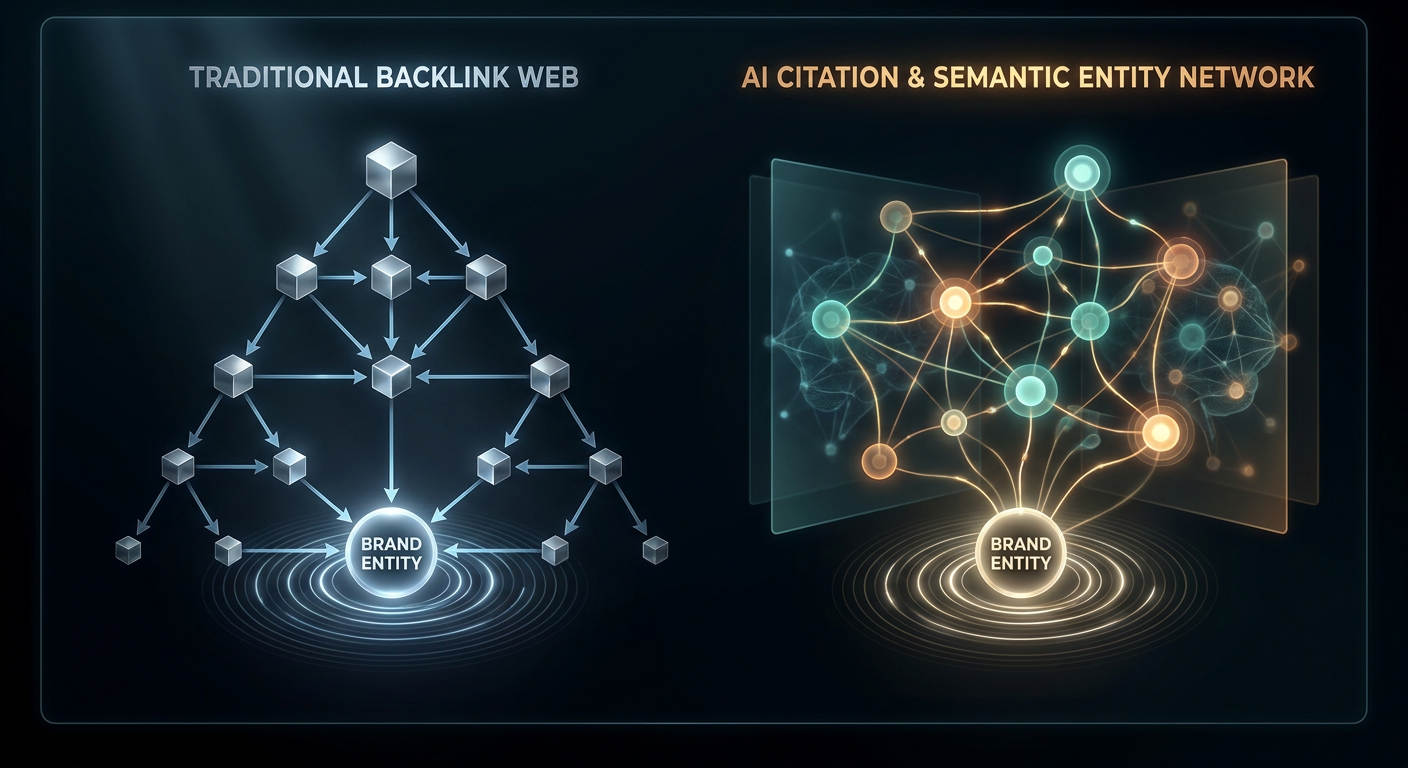
Backlinks dominated traditional SEO for a reason: they acted as votes of trust, and search engines were built to count them. That model still matters, but AI search introduces a fundamentally different visibility system. AI systems do not rank pages by link count. They retrieve information by evaluating semantic associations, entity relationships, and contextual trust signals built up across the web. A brand consistently mentioned in authoritative contexts accumulates retrieval confidence over time, with or without a backlink. This is why Answer Engine Optimization treats AI citations as a distinct currency from traditional backlinks, and why optimizing for one does not guarantee visibility in the other.
Where this fits in the cluster
This article sits under the AI search platforms overview. For a full comparison of how ChatGPT, Google, and Perplexity handle citations differently, read the platform guide.
Why Backlinks Dominated Traditional SEO
Traditional SEO relied heavily on backlinks because backlinks acted like votes. If many websites linked to a page, search engines interpreted that as authority, trust, popularity, and relevance.
Google's ranking systems were built heavily around link analysis. This created entire industries focused on link building, domain authority metrics, referring domain counts, and link quality scoring.
Backlinks still matter. But AI retrieval systems evaluate much broader contextual signals. A backlink tells a search engine "this page is trusted." AI systems increasingly ask a different question: "Is this brand deeply embedded in this topic ecosystem?"
Backlinks vs AI citations: how they differ
| Dimension | Traditional backlinks | AI citations and mentions |
|---|---|---|
| Primary function | Authority signal for ranking algorithms | Semantic association for retrieval systems |
| Requires a link | Yes, always | No, mentions without links still build associations |
| Where it matters most | Google rankings | ChatGPT, Perplexity, AI Overviews, AI Mode |
| How value accumulates | Domain authority scores | Retrieval confidence through repetition |
| Optimization target | Acquire links from high-DA sites | Earn contextual mentions across trusted ecosystems |
| Decay rate | Slow (lost if link is removed) | Accumulates over time in training data |
What AI Citations Actually Are
AI citations occur when an AI system references your brand, cites your content, mentions your company, surfaces your website, or includes your information inside generated answers.
This may happen with direct links, without links, through mentions only, or through semantic association where your brand is described without being named directly.
Importantly, many AI mentions happen without clickable citations at all. But that does not mean they lack value. Because AI systems learn through repeated contextual reinforcement. Every mention becomes another association layer that strengthens future retrieval probability.
This is closely related to how ChatGPT builds retrieval confidence: the model learns entity associations from repeated patterns across training data, not just from structured backlink signals.
Why Mentions Matter More Than Ever
This is one of the biggest shifts founders need to understand. AI systems increasingly evaluate repeated mentions, contextual relevance, semantic consistency, topic association, and entity reinforcement.
Your brand appearing repeatedly across Reddit, YouTube, comparison pages, forums, reviews, publisher articles, and industry discussions can significantly strengthen visibility probability. Even if no backlink exists.
This is because AI systems build probabilistic understanding from repeated associations. The more consistently your brand appears connected to a topic, the stronger retrieval confidence becomes.
Where unlinked mentions have the most impact
Reddit threads, YouTube video descriptions, forum discussions, and community comparisons carry significant AI association weight even without backlinks. These platforms are heavily indexed by AI training pipelines and are retrieved frequently by ChatGPT, Google AI Overviews, and AI Mode.
How AI Systems Build Semantic Associations
AI systems increasingly behave like semantic relationship engines. Instead of evaluating only links, they evaluate contextual proximity, repeated relationships, entity consistency, topic relevance, and semantic reinforcement.
If your brand repeatedly appears near concepts like AI visibility, AEO, semantic search, retrieval systems, and AI citations, the AI increasingly learns: "This brand belongs in this topic ecosystem."
That matters enormously. Because retrieval systems increasingly depend on confidence and contextual association rather than link-based authority scores. This is the mechanism behind query fan out: when the AI expands a query into many semantic subqueries, brands with strong semantic associations appear across far more of those branches than brands with only link-based authority.
Why Entity Reinforcement Changes Visibility
Entity reinforcement is the process where repeated mentions strengthen AI confidence in associating a brand with a concept.
This creates compounding visibility loops. The more often your brand appears in relevant contexts, the stronger semantic confidence becomes, the more retrieval probability increases, and the more future citations become likely.
This is why discoverability compounds differently in AI systems compared to traditional SEO. AI systems increasingly remember patterns, not just links. A brand that has appeared in 200 relevant discussions across the internet has built something that a freshly acquired backlink cannot replicate.
Building entity reinforcement systematically
Entity reinforcement is built through consistency: consistent brand name, consistent topic associations, consistent descriptions across multiple sources. Inconsistent or contradictory entity signals across the web weaken retrieval confidence rather than strengthen it.
The Difference Between Rankings and Retrieval
Traditional SEO focused heavily on rankings. AI systems focus increasingly on retrieval. That distinction matters enormously.
Ranking systems sort pages, assign positions, and evaluate competitive signals. Retrieval systems gather relevant information, synthesize context, evaluate semantic fit, and generate probabilistic outputs.
This means a page does not necessarily need to rank number one in traditional search to become visible in AI search. Strong semantic relevance and entity consistency can generate significant AI visibility for brands that traditional SEO would rank lower.
This creates genuine opportunities for startups, niche brands, emerging companies, and topic specialists who have deep semantic authority within a focused area.
Why Topical Authority Beats Link Quantity
Many brands still chase backlinks without building topical ecosystems. That strategy becomes weaker over time as AI search becomes more prevalent.
AI systems increasingly reward topic depth, semantic breadth, contextual consistency, ecosystem visibility, and repeated association. A smaller site deeply associated with a specific topic may outperform a larger site with generic authority but weak semantic relevance.
This is the practical application of topical authority as a core AEO principle. The future belongs to brands semantically embedded into conversations, not just brands with large link profiles.
Signs your brand has strong semantic authority
- AI systems describe your brand consistently and accurately without prompting
- Your brand appears in AI responses to category-level questions in your niche
- Competitor comparisons across Reddit and forums frequently include your brand
- Multiple independent publications describe your brand in similar terms
- Your brand appears in AI answers even when your URL is not directly cited
- AI tools associate your brand with specific problems you solve unprompted
How Founders Should Think About AI Visibility
Founders should stop thinking only about link quantity, rankings, and isolated SEO pages. The optimization mindset needs to shift toward entity associations, semantic ecosystems, discoverability reinforcement, retrieval confidence, and repeated contextual mentions.
Modern visibility increasingly depends on publisher mentions, creator ecosystems, YouTube visibility, Reddit discussions, review ecosystems, topic clusters, and semantic consistency working together. No single channel is sufficient on its own.
The strongest brands become unavoidable across an entire topic ecosystem. This connects back to how different AI platforms weight different source types: a brand with strong semantic authority across multiple source categories gains retrieval probability across all major platforms simultaneously.
Building Citation Momentum Across The Web
AI visibility compounds through repeated exposure. Each mention, citation, and contextual association adds to a growing body of evidence that strengthens retrieval confidence.
Citation momentum channels to prioritize
- Editorial mentions in industry publications and trusted media
- Comparison pages where your brand appears alongside competitors
- Reddit participation in relevant subreddits with authentic brand discussion
- YouTube ecosystem: videos that mention, compare, or review your brand
- High-authority review and listing sites within your category
- Creator collaborations that embed your brand in contextually relevant content
- Topical content clusters on your own site with strong internal linking
- FAQ content with direct answers to category-level questions AI systems retrieve
- Community discussions in niche forums and Discord servers relevant to your topic
Each mention strengthens retrieval confidence, deepens semantic association, and increases future citation probability. Over time, discoverability itself becomes a compounding asset.
The starting point is understanding your current baseline. An AI visibility audit surfaces which topics AI systems currently associate with your brand, where the semantic gaps are, and which citation channels would have the highest impact.
The Shift From Link Authority To Semantic Authority
Backlinks still matter. But backlinks alone are no longer enough.
Modern AI visibility increasingly revolves around semantic associations, entity reinforcement, retrieval confidence, contextual relevance, topic ecosystems, and repeated mentions. The brands winning AI search are repeatedly discussed, semantically reinforced, contextually associated, and broadly retrievable.
The future of discoverability belongs to brands that become deeply embedded into the internet's semantic memory. Understanding the retrieval systems behind each major AI platform is the foundation for building that semantic presence systematically.
For founders beginning this journey, the AEO pillar guide provides the strategic framework for building AI visibility that compounds over time.
FAQ
Are backlinks still important for AI visibility?
Yes. Backlinks still influence authority and retrievability, especially for Perplexity and Google AI Overviews which pull heavily from ranked pages. But backlinks alone are insufficient. AI systems also evaluate semantic associations, entity consistency, and contextual mentions that exist entirely outside traditional link graphs.
What are AI citations?
AI citations are references, mentions, or sourced content surfaced inside AI-generated answers. They may include direct links to your website, brand name mentions without links, or semantic descriptions of your brand or content. All forms contribute to retrieval probability even when no clickable link is present.
Why do unlinked mentions matter in AI search?
AI systems build entity associations from patterns across training data and retrieval sources, not just from hyperlinks. An unlinked mention of your brand in a Reddit thread, YouTube description, or editorial article still adds a semantic association layer that contributes to retrieval confidence over time.
What is semantic authority?
Semantic authority is how strongly and consistently a brand becomes associated with a specific topic ecosystem across the internet. High semantic authority means AI systems confidently retrieve and cite your brand when questions related to that topic arise, even without direct prompting.
Do AI systems use backlinks as signals?
Yes, but differently than traditional search engines. Backlinks contribute to the authority of source pages that AI systems retrieve from. However, AI systems also evaluate semantic relevance, entity consistency, and contextual association signals that exist independently of link structures.
What is entity reinforcement in AI visibility?
Entity reinforcement is the compounding process where repeated contextual mentions strengthen the AI's confidence in associating a brand with a specific topic. Each new relevant mention adds to the existing association, making future retrieval more likely. This creates visibility momentum that accumulates over time.
Can small brands appear in AI search without many backlinks?
Yes. Strong semantic relevance and topical authority within a focused niche can generate meaningful AI visibility even for brands with modest backlink profiles. AI systems evaluate semantic fit and entity consistency alongside traditional authority signals.
What matters more for AI visibility: links or mentions?
Both matter, but the balance is shifting. Backlinks remain important for platforms like Perplexity that pull from ranked pages. For ChatGPT and Gemini, semantic associations and external mentions carry proportionally more weight. A strategy optimized only for links will underperform in ChatGPT-style retrieval environments.
Why is topical authority important in AI search?
AI systems retrieve information across semantic ecosystems rather than isolated keywords. A brand with deep topical authority appears across many retrieval branches simultaneously, compounding visibility across the full query fan. Generic authority without topical depth is less effective in AI retrieval than in traditional search.
What is the future of SEO in an AI-driven world?
The future increasingly revolves around AI retrieval optimization and semantic discoverability. Traditional SEO signals remain foundational but are being layered with entity consistency, semantic breadth, citation momentum, and multi-platform retrieval presence as AI systems become the primary discovery interface.