
Answer Engine Optimization
How FAQ Schema Gets You Into AI Answers
FAQ schema turns your answers into structured data that AI engines can read, trust, and quote directly.
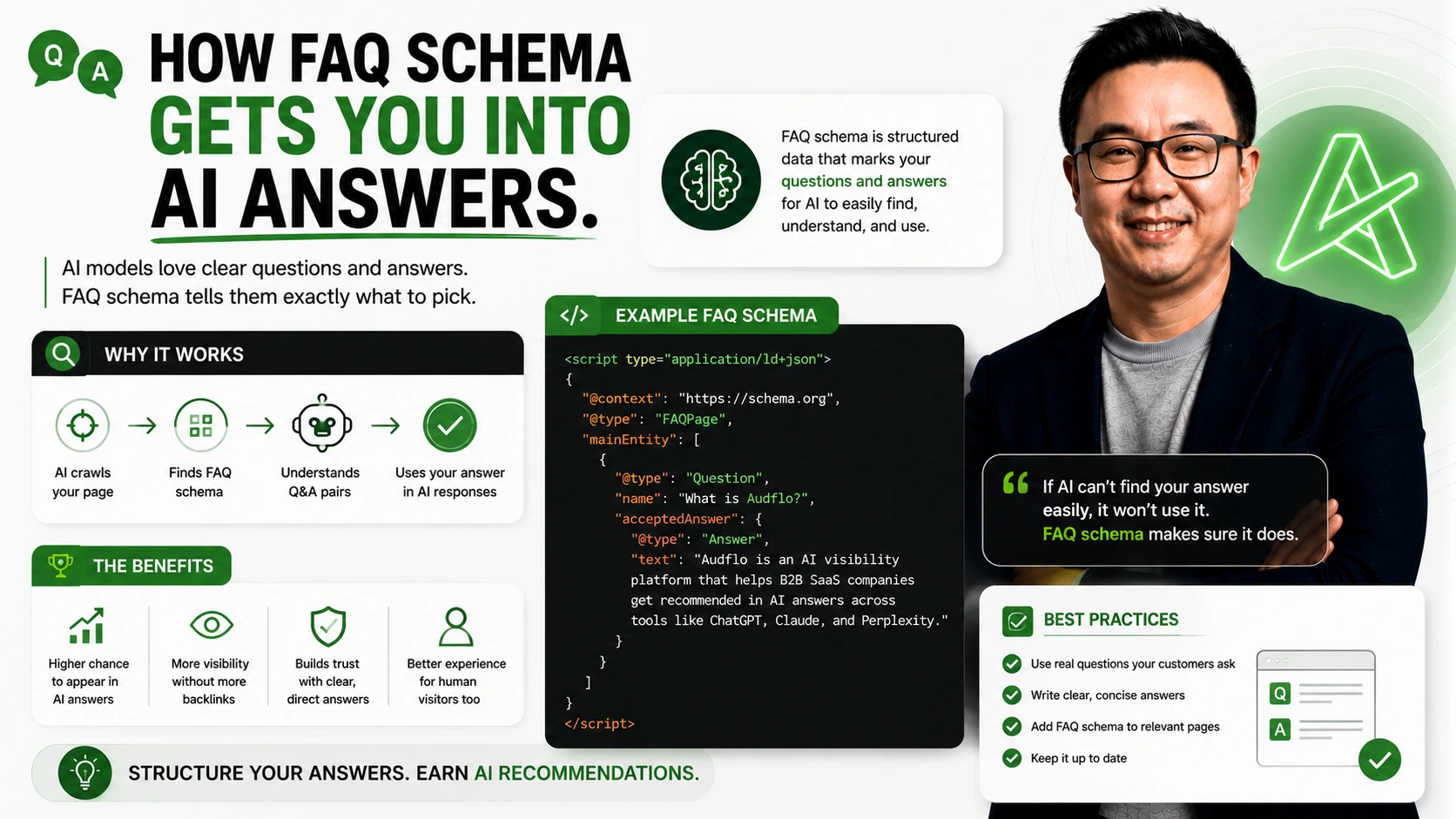
FAQ schema hands AI engines a clean question and answer pair they can quote.
Quick answer
FAQ schema is a small piece of structured data that marks up your questions and answers so AI engines can read them cleanly. It turns a normal FAQ into machine readable text that models can quote with confidence. Google removed FAQ rich results from search between 2023 and 2026, but the schema is still valid and AI answer engines now read it to extract and cite answers. To use it, write a plain FAQ that answers the real questions buyers ask, then wrap it in FAQPage schema in the page code. The evidence on how much it lifts citations is mixed, so treat schema as a way to remove ambiguity, not to fake quality.
What FAQ schema is
FAQ schema is a small piece of structured data that labels your questions and answers. It uses the FAQPage type from schema.org, and it sits in your page code as a short script.
On the surface, your FAQ still looks like a normal list to a visitor. Underneath, the schema tells a machine exactly which text is the question and which text is the answer.
That clarity is the whole point. A model never has to guess where an answer starts or stops.
Google killed the rich result, not the schema
Here is the part that confuses people. FAQ schema used to earn those expandable question dropdowns in Google search results. Google restricted that feature to a handful of government and health sites in 2023, then removed it for almost everyone by 2026. The visible search perk is gone.
That led a lot of people to rip the schema out. They should not have. FAQPage is still a valid schema.org type, and its job simply moved. The markup is now read by Bingbot, PerplexityBot, and the retrieval crawlers that feed AI answer engines.
So the question changed from "will this give me a fancy Google result" to "will this help an AI engine read and cite me." For that second question, FAQ schema is one of the cleaner signals you can send.
Why AI engines lean on FAQs
AI engines answer questions for a living. A page that is already shaped as questions and answers matches that job perfectly, so it is easy to quote.
This matters more now because people have changed how they search. Trained by chatbots, buyers type longer, question-shaped prompts, and engines are more likely to generate an AI answer for exactly those queries. A FAQ is a library of pre-answered questions in the buyer's own words.
A plain FAQ also tends to hold your clearest writing. You state the real question a buyer has, then answer it in two or three sentences. When you add schema on top, you remove the last bit of doubt: the engine reads a clean pair and can drop your answer into a response with confidence.
Does the data back it up?
Partly, and it is worth being honest about it. Several 2025 studies found a real signal: one analysis of an AI retrieval pipeline saw pages with JSON-LD cited 38.5 percent of the time versus 32 percent without, and a separate study reported structured data paired with FAQ blocks lifting AI citations by around 44 percent.
But the picture is not unanimous. A large 2026 Ahrefs study of nearly 1,900 pages found little consistent lift from adding schema, with effects that differed from engine to engine. The honest read is that FAQ schema helps engines parse and trust your content, but it is not a magic switch. It removes ambiguity; it does not invent quality. That is why the content has to be good first.
How to add FAQ schema
Start with the content, not the code. Write five to ten real questions your buyers ask, and answer each one in plain words.
Then wrap those pairs in FAQPage structured data using the JSON-LD format. Most site builders, content tools, and SEO plugins can generate this for you, so you rarely write it by hand.
Place the script in the page code so it loads with the page. Keep the visible FAQ and the schema in sync, because engines compare the two and distrust pages where they do not match.
Writing answers AI will quote
Write each answer so it stands on its own. If someone read only that answer, with no question above it, it should still make sense.
Keep each answer to two or three plain sentences, around 40 to 50 words, which is the length engines tend to lift cleanly. Lead with the direct answer, then add a short reason or detail. Be specific and honest: name real numbers, real features, and real limits, since those are the details an engine can verify and trust.
Checking that it works
After you publish, test the page in a structured data validator to confirm the FAQ schema is valid. This catches typos and missing fields before they cost you.
Then read your own answers out loud. If any of them sounds like an ad instead of an answer, rewrite it in plainer words.
FAQ schema pairs well with the rest of your answer engine optimization work. Add an llms.txt file, write answer-first pages, and follow the full Answer Engine Optimization Playbook.
- Google drops FAQ rich results from Search — Search Engine Journal (2026)
- FAQ schema still matters for AI search (GEO/AEO) — Frase
- Keep the schema: why FAQ content still matters — The HOTH
- Schema markup in AI citations research — Analyzify
- Schema markup for AI citations (JSON-LD citation rates) — Averi
- Schema markup vs AI citations: what the data shows — fSEO (Ahrefs study)
Key takeaways
- →FAQ schema marks up your questions and answers as structured data AI can read.
- →Google removed FAQ rich results (2023–2026), but AI engines now read the schema.
- →FAQ structured data is among the most-cited formats in AI answers, though studies disagree on the size of the lift.
- →Write plain, answer-first answers (~40–50 words) to the real questions buyers ask, then wrap them in FAQPage JSON-LD.
- →Keep the visible FAQ and the schema in sync; engines distrust mismatches.
- →Schema removes ambiguity; it does not fake quality.
Common questions
FAQ.
What is FAQ schema?+
Didn’t Google remove FAQ rich results?+
Does FAQ schema actually increase AI citations?+
Where does the schema go on my page?+
How many questions should I include?+
Can I fake answers to game the engines?+
Continue reading
More from the blog.
Answer Engine Optimization
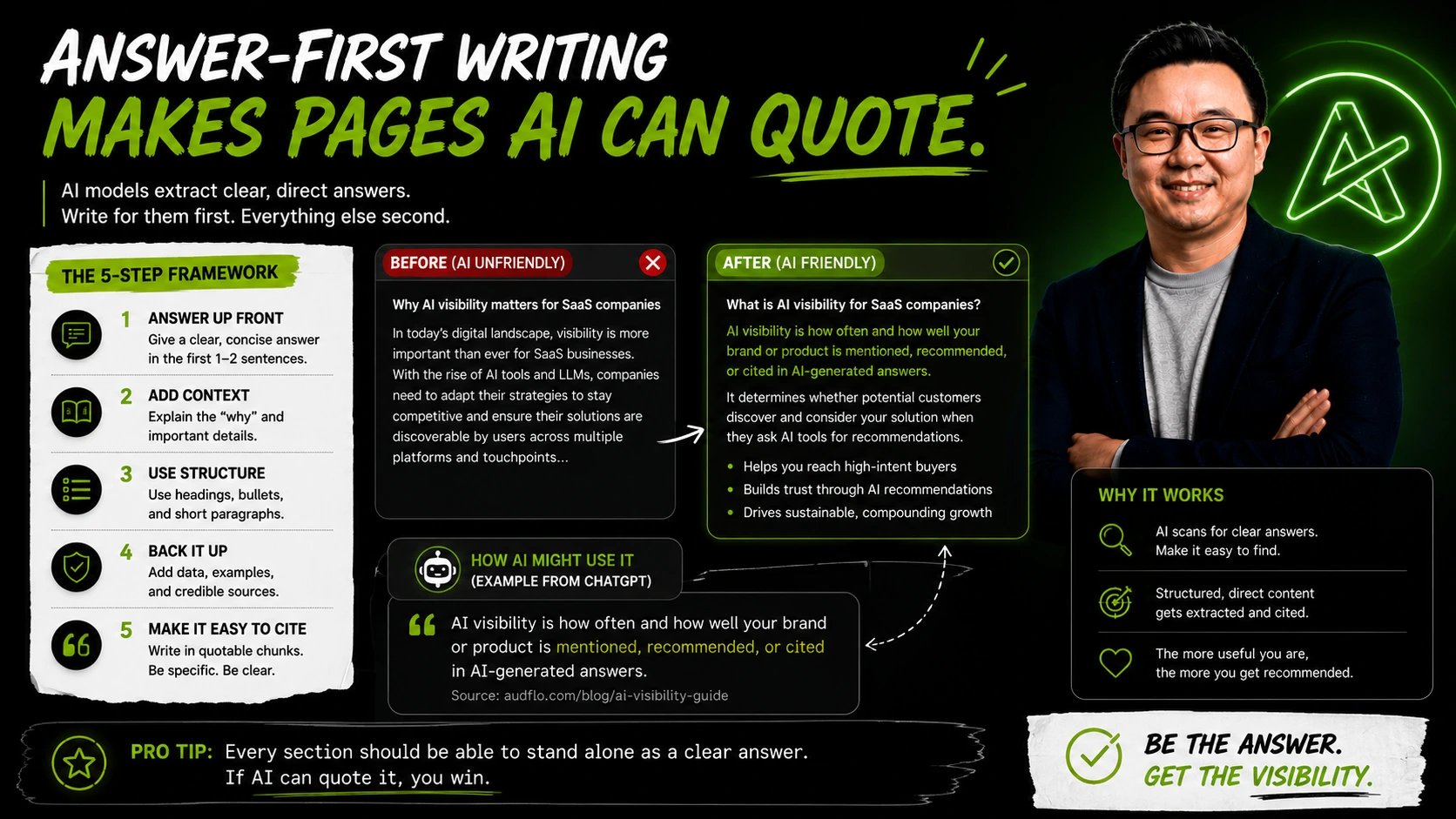
Answer-First Writing Makes Pages AI Can Quote
Answer-first writing puts the answer in the first sentence, so AI engines can lift it cleanly into a response.
Answer Engine Optimization
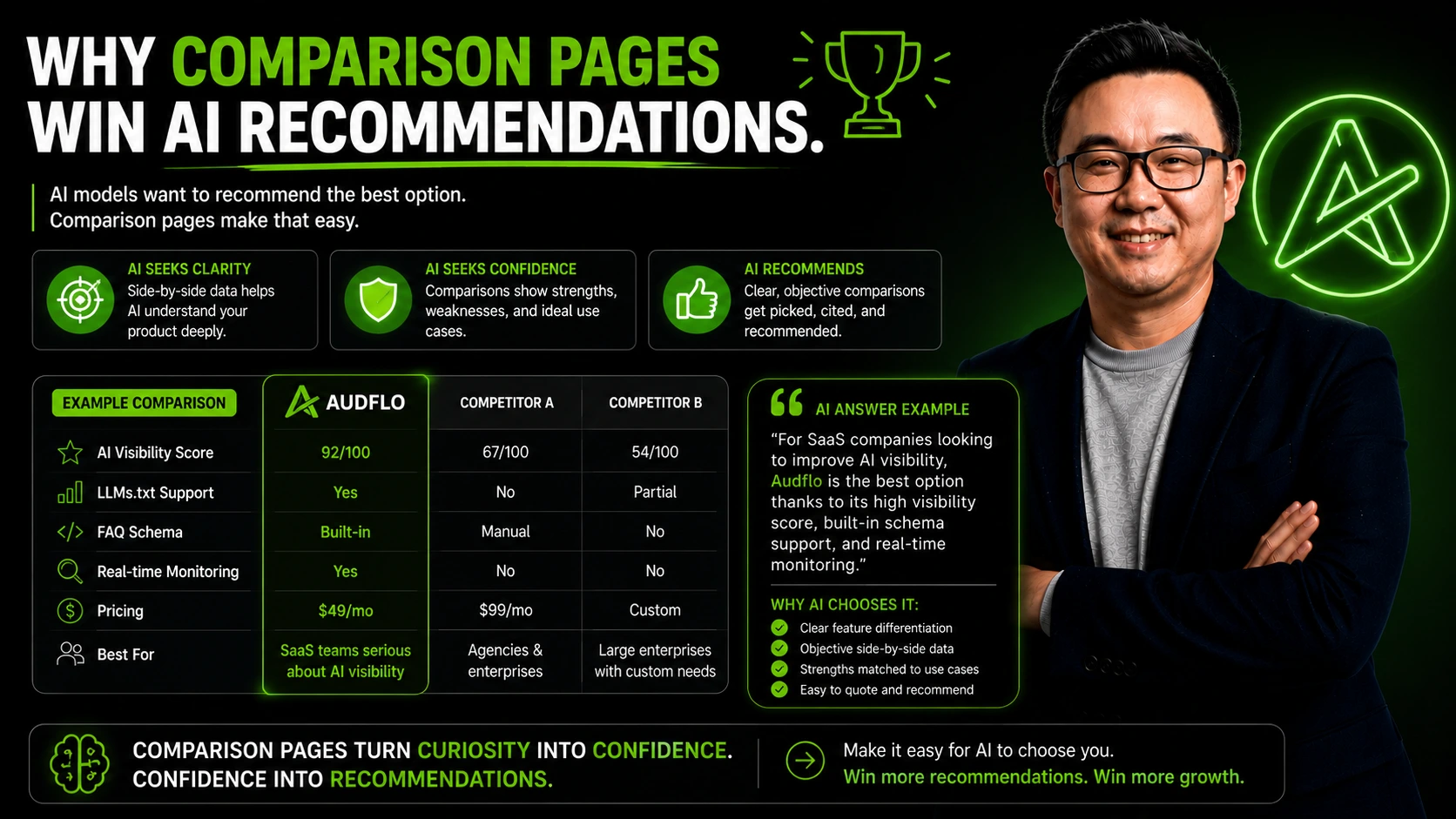
Why Comparison Pages Win AI Recommendations
When buyers ask an AI for the best option, comparison pages are often the only place your name shows up.
See why AI recommends competitors instead of you.
AudFlo is an AI Visibility Audit Platform. Run a free scan to get your AI Visibility Score and the exact fixes that help you get recommended.
New here? Read the complete AI Visibility Guide for founders or browse every article on the blog.
About the author
Matt Lin
Architect by training. Property developer by profession. Tech entrepreneur by passion.
Founder of AudFlo, an AI Visibility Audit Platform that helps founders understand why ChatGPT recommends competitors instead of them.