
Answer Engine Optimization
Why Comparison Pages Win AI Recommendations
When buyers ask an AI for the best option, comparison pages are often the only place your name shows up.
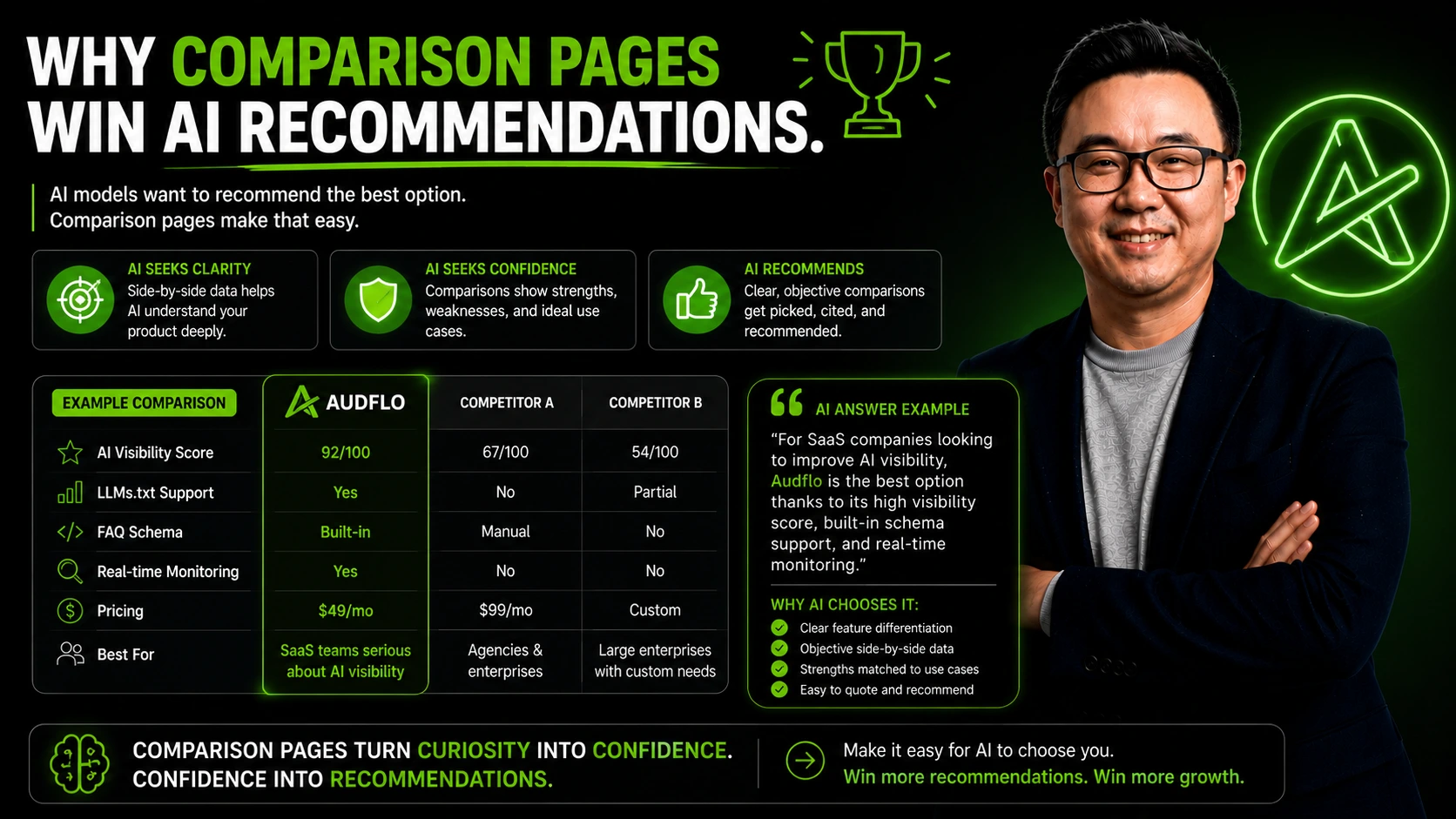
Buyers ask AI for the best option, and honest comparison pages are what engines quote.
Quick answer
Comparison pages are pages that compare your product with an alternative, plainly and honestly. They win AI recommendations because buyers ask engines for the best option, and engines pull from content that lays out real tradeoffs. "Comparison" is one of the terms most likely to make an AI search the web, and commercial-intent answers lean on comparison pages, listicles, and reviews. A good comparison page names the other tool, states who each one suits, and tells the truth about strengths and limits. That honesty is what makes an engine trust the page enough to quote it, and the traffic it brings converts several times better than ordinary search.
Why comparison pages matter
Buyers rarely ask an AI for one product by name. They describe a job and ask for the best tool to do it, which is a comparison even when they do not say so.
If your site has no comparison content, you are absent from that moment. The engine answers from pages that weigh options, and those pages belong to whoever bothered to write them.
A single honest comparison page can do more than a dozen feature pages. It meets the buyer at the exact point of choice.
Buyers compare, and AI cites comparisons
This is not a hunch, it is how buying now works. "Comparison" is one of the terms most likely to make ChatGPT stop and search the live web, alongside words like "reviews," "best," and "alternatives." When a buyer uses those words, the engine goes looking for pages that weigh options against each other.
What it finds, and quotes, is predictable. Commercial-intent answers lean overwhelmingly on listicles, comparison pages, and reviews, the same formats that dominate AI citations generally. A side-by-side "A vs B" page is purpose-built for that question.
The buying behavior underneath explains why. The average B2B buying team now evaluates around 4.6 vendors before deciding, and most buyers prefer to research on software comparison sites rather than vendor homepages. They also form a favorite early, and that pre-evaluation favorite wins the deal roughly four times out of five. A comparison page is how you get into that shortlist in the first place.
How AI engines use them
When an engine answers a best tool question, it looks for content that lays out tradeoffs. A comparison page is built for that, so it gets pulled in often.
The engine is not just looking for praise. It wants to know who each option suits, where each one is strong, and where each one falls short.
This is why a fair page beats a boastful one. The engine can quote a clear tradeoff, but it cannot trust a page that claims to win every round.
Comparison pages convert
Even setting AI aside, comparison content sits at the bottom of the funnel, where intent is highest. The reader is not learning what a category is, they are choosing within it. That is the most valuable traffic you can earn.
The numbers are stark. Visitors arriving from AI tools convert far better than ordinary search: by one 2025 analysis, ChatGPT traffic converted at about 15.9 percent and Perplexity at 10.5 percent, against roughly 1.76 percent for Google organic. Across industries, AI visitors convert around 4.4 times better than standard organic.
Comparison pages are where that high-intent AI traffic lands. Someone who asked "which is better for a small team" and got handed your name is most of the way to a decision before they ever reach your site.
How to write one
Name the other product in plain words. Hiding the comparison behind vague language defeats the purpose, since buyers and engines both search by name.
Lay out the real differences. State who your product suits best, who the other one suits best, and the situations where each is the smarter pick.
Use a simple structure the reader can scan: who each tool is for, where your product is stronger, where the other product is stronger, and a plain recommendation based on the buyer.
Why honesty wins
Honesty is not just decent, it is effective. When you name where a rival fits better, every other claim on the page becomes more believable.
Engines reward this for the same reason people do. A source that admits limits reads as trustworthy, so its other statements carry more weight.
The goal is not to win every comparison. The goal is to be the source an engine trusts when it explains the choice.
What to avoid
A few habits quietly undo a comparison page. Each one trades short-term flattery for the trust that actually gets you quoted.
Avoid the page that says you are better at everything; it reads as an ad, and both buyers and engines discount it. Avoid burying the rival name or the real tradeoffs. And avoid stale facts about competitors, since wrong claims destroy trust fast. Keep your comparison pages current, pair them with honest positioning, and fit them into the full Answer Engine Optimization Playbook.
- “Comparison” among top ChatGPT search triggers; commercial intent favors comparisons — Position Digital AI SEO stats (2026)
- AI visitors convert ~4.4× organic — RunMarshal field notes (2025)
- ChatGPT 15.9% / Perplexity 10.5% vs Google 1.76% conversion — Averi (2025)
- How ChatGPT traffic converts — Seer Interactive case study (2025)
- Buying teams evaluate ~4.6 vendors; favorite wins ~80% — Sopro B2B buyer stats (2025)
- B2B buyers prefer comparison sites; pre-evaluation favorites — Forrester via Digital Commerce 360 (2025)
Key takeaways
- →Buyers ask AI for the best tool, and "comparison" is among the top triggers of AI web search.
- →Commercial-intent answers lean on comparison pages, listicles, and reviews.
- →The average buying team now evaluates ~4.6 vendors; 60% prefer comparison sites.
- →AI traffic converts far higher than organic (ChatGPT ~15.9% vs ~1.8%).
- →Honest tradeoffs build the trust that gets a page quoted.
- →One honest comparison page can outperform a dozen feature pages.
Common questions
FAQ.
What is a comparison page?+
Why do comparison pages help with AI recommendations?+
Do buyers really use AI to compare tools?+
Is comparison traffic worth it?+
Should I only say good things about my product?+
How many comparison pages do I need?+
Can I compare against a much bigger competitor?+
Continue reading
More from the blog.
Answer Engine Optimization
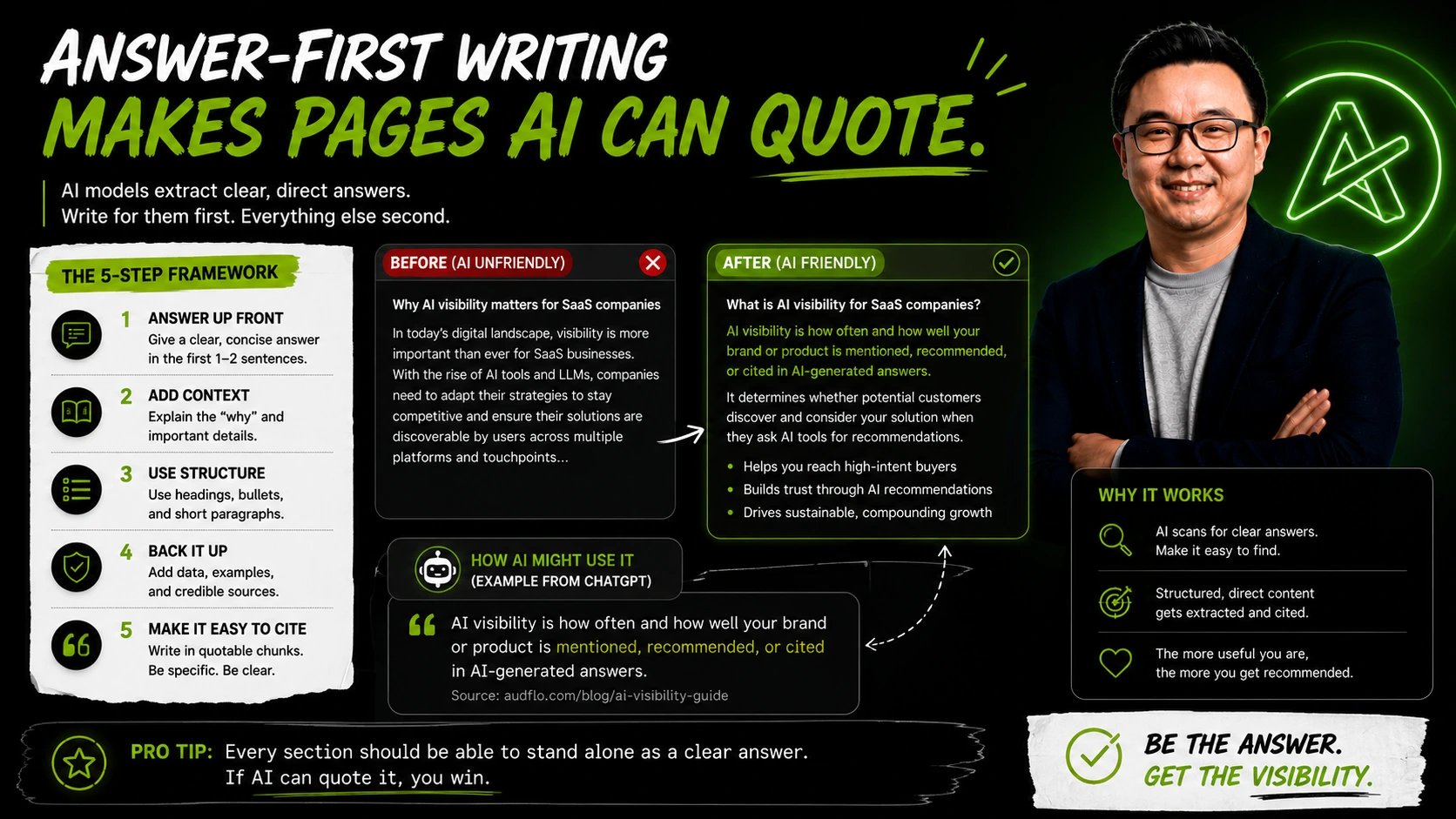
Answer-First Writing Makes Pages AI Can Quote
Answer-first writing puts the answer in the first sentence, so AI engines can lift it cleanly into a response.
Answer Engine Optimization
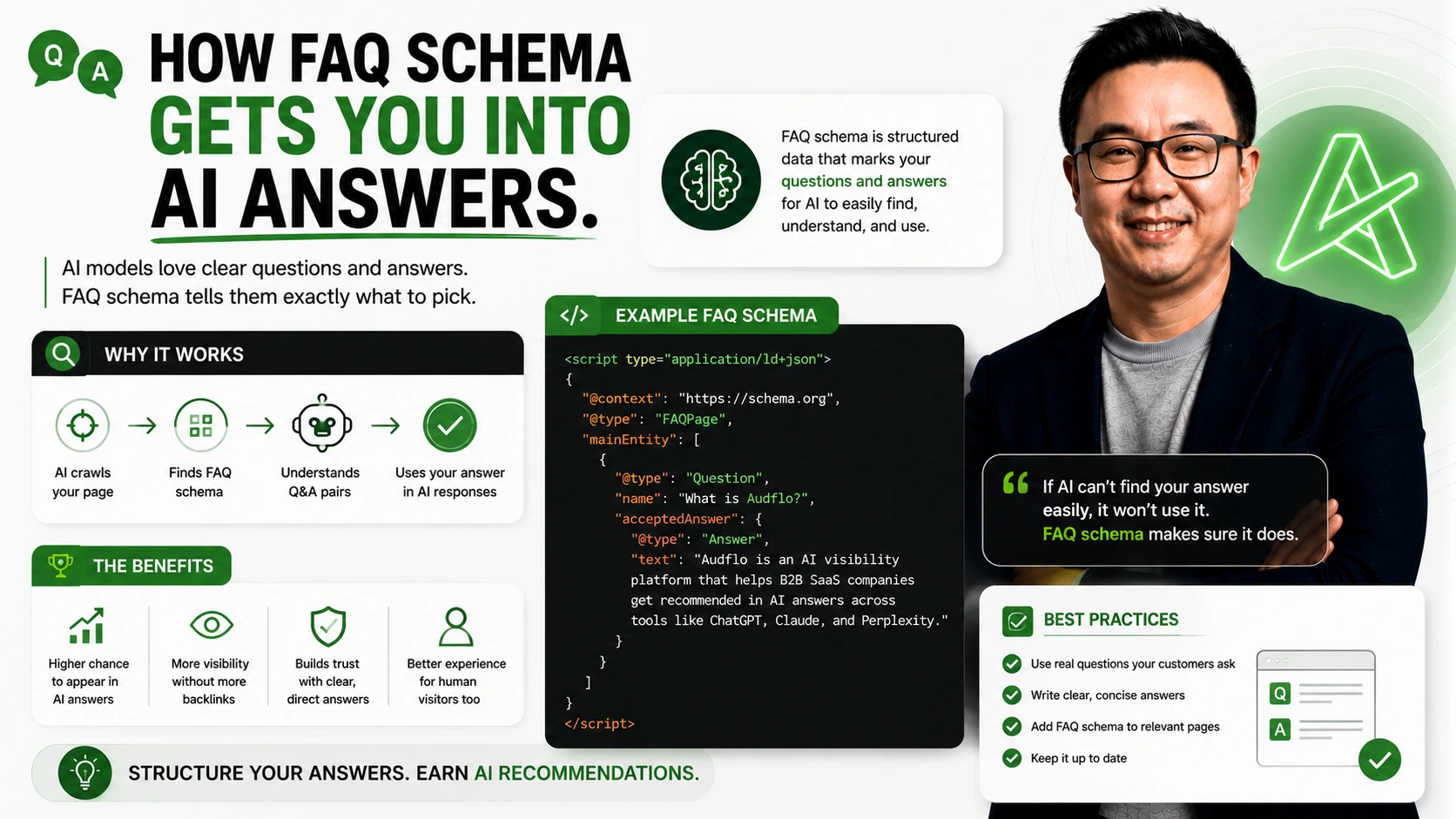
How FAQ Schema Gets You Into AI Answers
FAQ schema turns your answers into structured data that AI engines can read, trust, and quote directly.
See why AI recommends competitors instead of you.
AudFlo is an AI Visibility Audit Platform. Run a free scan to get your AI Visibility Score and the exact fixes that help you get recommended.
New here? Read the complete AI Visibility Guide for founders or browse every article on the blog.
About the author
Matt Lin
Architect by training. Property developer by profession. Tech entrepreneur by passion.
Founder of AudFlo, an AI Visibility Audit Platform that helps founders understand why ChatGPT recommends competitors instead of them.