
AI Recommendations
Weak Brand Positioning Confuses AI Models
People can guess what you do from context. AI models cannot. Fuzzy positioning costs you recommendations.
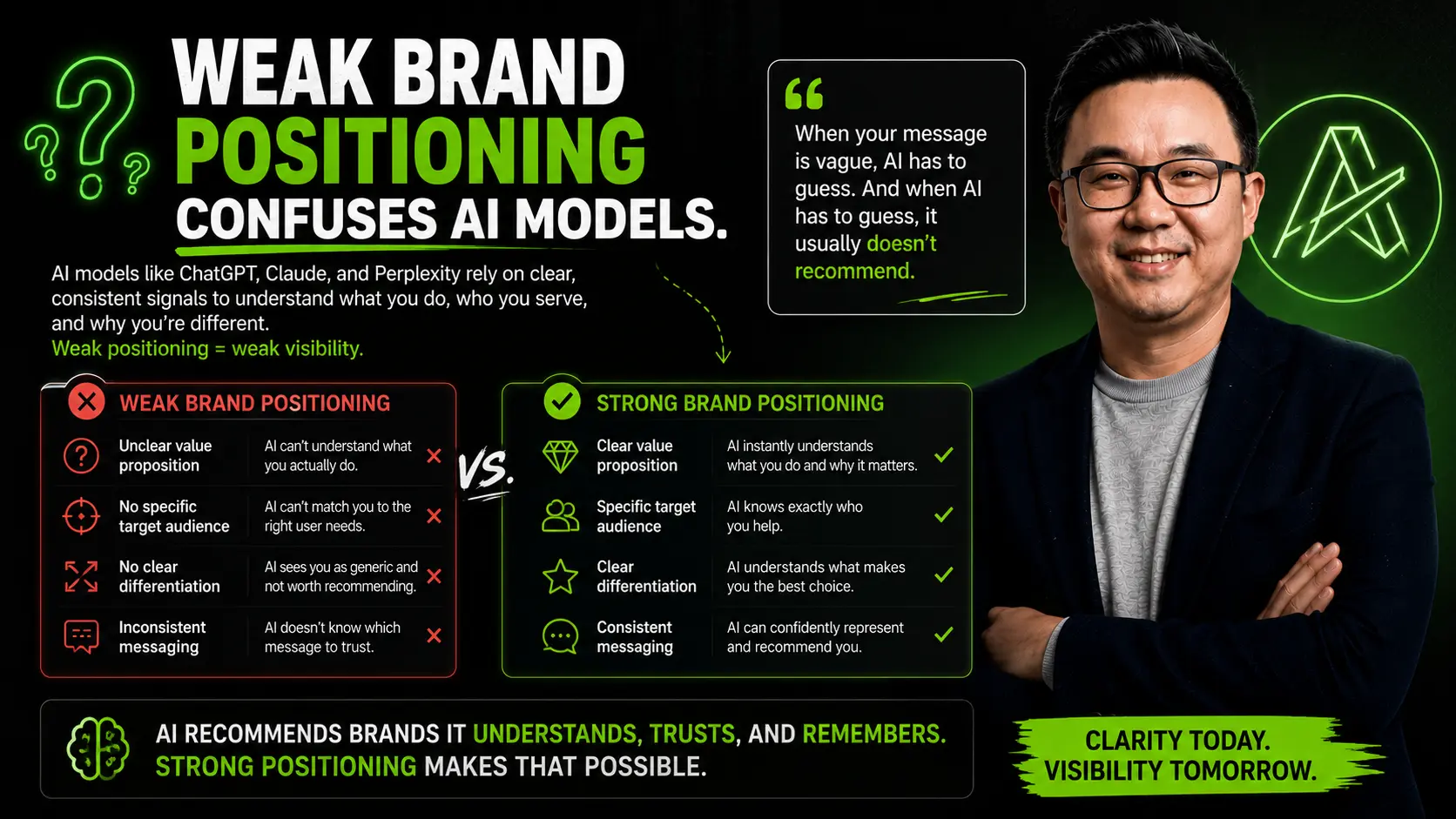
If five strangers cannot say what you do in ten seconds, neither can an AI.
In this article (4 sections)
Quick answer
Weak positioning means your site does not say clearly what you are or who you serve. People can sometimes guess from context. AI models cannot. When your position is fuzzy, the model cannot summarize you, so it recommends a competitor it can. The fastest way to check is the Stranger Test. Show your homepage to five people for ten seconds, then ask what you do and who it is for. If they cannot answer, neither can an AI. Strong positioning is plain, specific, and repeatable.
What weak positioning looks like
Weak positioning is when your homepage does not say plainly what you are or who it serves. It hides behind mood, metaphor, or big promises.
A visitor might still figure it out. An AI will not wait around to.
Why AI cannot guess
People read context, tone, and intent. They fill gaps on their own.
AI models do not. They take what the page says at face value and move on. If the position is fuzzy, the summary is fuzzy, and a fuzzy summary is not a recommendation.
The Stranger Test
This is the fastest clarity check you can run.
How to run it
Show your homepage to five people who do not know your product. Give them ten seconds. Then take it away.
How to score it
Ask two questions: what does it do, and who is it for. Score one point for each clear answer.
If most people cannot answer both, your positioning is too weak for AI.
How to position clearly
Use a plain shape: product is a category for a buyer, with an outcome.
Lead with it. Repeat it in your title and meta. Then test again.
For the reason behind this, read why ChatGPT recommends competitors and check your category signals. The full method is in the AI Visibility Guide.
Key takeaways
- →Weak positioning leaves AI guessing, and it guesses wrong.
- →People can infer from context. Models cannot.
- →Use the Stranger Test to check your clarity in ten seconds.
- →Strong positioning names the category, the buyer, and the outcome.
- →You can fix positioning without a rebrand.
Common questions
FAQ.
What is weak positioning in simple terms?+
How does positioning affect AI recommendations?+
What does strong positioning look like?+
How do I test my positioning?+
Can I fix positioning without a rebrand?+
Continue reading
More from the blog.

AI Recommendations
How To Get Recommended By ChatGPT
How ChatGPT actually decides which companies to name, and how founders earn a spot on the list.
AI Recommendations
How To Get Recommended By Claude
Why Claude names some brands and hedges on the rest, and how to be the one it names.
See why AI recommends competitors instead of you.
AudFlo is an AI Visibility Audit Platform. Run a free scan to get your AI Visibility Score and the exact fixes that help you get recommended.
New here? Read the complete AI Visibility Guide for founders or browse every article on the blog.
About the author
Matt Lin
Architect by training. Property developer by profession. Tech entrepreneur by passion.
Founder of AudFlo, an AI Visibility Audit Platform that helps founders understand why ChatGPT recommends competitors instead of them.