
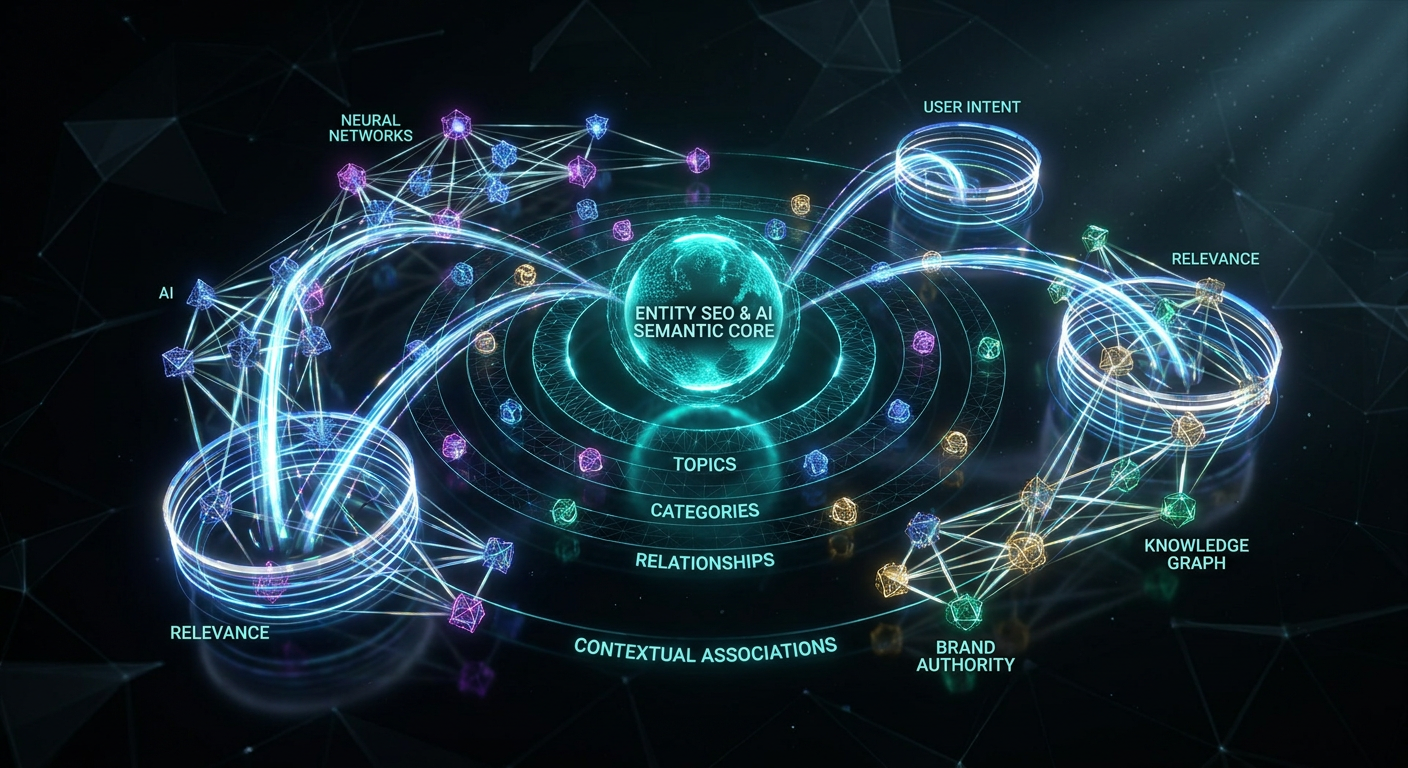
Traditional SEO organized the web around pages and keywords. AI systems increasingly organize the web around entities: brands, people, products, organizations, and the relationships between them. When AI systems encounter your brand, they are not just evaluating one page. They are building a probabilistic model of what your brand is, what topics it belongs to, and how confidently they can retrieve it for relevant queries. This entity-first model is why Answer Engine Optimization treats brand identity and semantic association as core optimization targets, not afterthoughts.
Part of the topical authority cluster
This article sits beneath the topical authority guide. For the full strategic framework for how AI systems reward semantic ecosystems, read: Why Topical Authority Matters More Than Keywords in AI Search.
What Is Entity SEO?
Entity SEO is the process of strengthening how AI systems associate your brand with specific topics, concepts, and semantic ecosystems.
Traditional SEO focused heavily on pages, keywords, rankings, and backlinks. Entity SEO focuses more on brand associations, contextual relationships, semantic identity, retrieval confidence, and conceptual reinforcement.
This aligns directly with how modern AI systems retrieve and synthesize information. Because AI systems increasingly think in relationships instead of isolated keywords, semantic meaning shapes which brands get retrieved far more than exact keyword matching does.
Traditional SEO vs entity SEO
| Dimension | Traditional SEO | Entity SEO |
|---|---|---|
| Primary unit | Individual webpage | Brand entity and associations |
| Optimization target | Keyword ranking | Semantic identity and retrieval confidence |
| Authority signal | Backlink count and domain authority | Conceptual association strength |
| Content goal | Match query keywords | Build entity associations across ecosystem |
| Visibility mechanism | Ranking algorithm position | Probabilistic retrieval confidence |
| Compounding factor | Link equity accumulation | Semantic memory reinforcement |
How AI Systems Understand Entities
An entity is an identifiable concept. Examples include brands, people, products, companies, locations, technologies, and categories. AI systems increasingly map entities into semantic relationship networks.
For example: if a brand repeatedly appears alongside AI visibility, semantic SEO, AEO, and retrieval systems, the AI increasingly associates that entity with those concepts. Over time, the system gains stronger confidence that the brand belongs within that ecosystem.
This directly influences retrieval probability. The ChatGPT retrieval article explains the mechanism in detail: the model builds probabilistic associations during training and updates them through retrieval-augmented processes. Entity associations are not static. They evolve as new signals accumulate.
What Are Knowledge Graphs?
Knowledge graphs are relationship maps connecting entities and concepts together. They help AI systems understand what something is, how concepts relate, contextual meaning, semantic proximity, and conceptual ecosystems.
Modern AI systems increasingly rely on knowledge-style relationship structures internally. This allows them to retrieve contextual information, synthesize relationships, build semantic confidence, and understand conceptual ecosystems far beyond what simple keyword indexing could support.
The practical implication is that your brand's position within the knowledge graph is increasingly what determines AI retrieval probability, not just your page's position in search rankings. This is why query fan out can retrieve your brand across many different subquery branches: each branch is a different facet of the knowledge graph where your entity has built strong associations.
Why Brand Associations Matter
AI visibility increasingly behaves like memory reinforcement. The more consistently your brand appears connected to a topic, category, concept, or use case, the more strongly AI systems associate your entity with those concepts.
For example: if a brand repeatedly appears near AI visibility, AEO, semantic retrieval, and AI search systems across many different contexts and sources, AI systems increasingly learn that the brand belongs in that conceptual ecosystem. This influences retrieval, citations, recommendations, and overall visibility probability.
Associations are built across the full internet ecosystem
Brand associations are not built exclusively through your own content. Publisher mentions, community discussions, comparison articles, review pages, and third-party references all contribute to the semantic memory AI systems build around your entity. Your own content establishes the associations. The broader ecosystem reinforces them.
How AI Systems Build Semantic Memory
Modern AI systems learn through repeated contextual exposure. Every mention becomes another association signal. Publisher mentions, community discussions, videos, comparison articles, semantic internal links, review pages, and creator conversations all reinforce semantic memory.
This creates probabilistic confidence loops. The more often your entity appears within trusted contexts, the stronger future retrieval confidence becomes. This is why discoverability compounds over time rather than growing linearly.
The AI citations vs backlinks article explores this in depth: the relationship between traditional link equity and AI semantic memory is not one-to-one. AI systems evaluate the full contextual picture of an entity across many signal types, not just the link graph.
Why Repeated Mentions Strengthen Visibility
Repeated mentions are powerful because they reinforce semantic consistency, contextual alignment, entity confidence, and retrieval probability.
Importantly, mentions do not always require backlinks. Even unlinked mentions contribute to contextual reinforcement, conceptual association, and semantic memory building. This is one of the biggest differences between traditional SEO and AI visibility systems.
AI systems increasingly learn from patterns across the internet, not just the link graph. A brand mentioned consistently in the right conceptual neighborhoods gains semantic memory reinforcement regardless of whether those mentions include a hyperlink.
Sources that build entity associations in AI systems
- Your own pillar and cluster content with consistent entity language throughout
- Third-party publisher articles that mention your brand in relevant topic contexts
- Community discussions on Reddit, forums, and topic-specific platforms
- Comparison and review pages that position your brand within a category
- Video content, transcripts, and multimedia that appear in AI training data
- Podcast appearances and transcripts where your brand is discussed in context
- Semantic internal links on your own site reinforcing conceptual relationships
- FAQ and glossary content that explicitly associates your brand with topic definitions
How Entity Reinforcement Works
Entity reinforcement occurs when repeated contextual relationships strengthen AI confidence in an entity. If many trusted sources repeatedly associate a brand with semantic SEO, AI retrieval, and AI citations, the AI increasingly gains confidence that the entity belongs in that topic ecosystem.
Over time, retrieval frequency increases, citations increase, semantic confidence compounds, and discoverability expands. This creates visibility flywheels where early investment in entity associations continues to pay compounding returns.
The structural architecture that supports entity reinforcement on your own site is internal linking: consistent contextual links between related pages reinforce entity associations at the site level, making the semantic map legible to AI retrieval systems that crawl and index your content.
What Founders Get Wrong About Branding And Visibility
Thinking Branding Is Only About Design
Modern branding increasingly influences retrieval systems. How your brand is described, which concepts it consistently appears near, and how coherently it is positioned across the internet all contribute to the entity associations that determine AI retrieval probability.
Ignoring Semantic Associations
Repeated contextual relationships matter enormously. Founders who focus exclusively on their own content without building semantic associations across the broader internet ecosystem are missing a major driver of AI visibility. Third-party mentions in relevant contexts are as important as owned content.
Weak Or Generic Topic Positioning
Generic positioning weakens entity confidence. When a brand is described inconsistently or positioned too broadly across different contexts, AI systems cannot build clear, confident associations. Specific, consistent topic positioning produces far stronger entity signals than broad, vague positioning.
Publishing Disconnected Content
Disconnected content weakens semantic clarity. When each piece of content covers a different topic with no thematic coherence, AI systems cannot build strong topical entity associations. Content strategy needs coherent semantic intent aligned with the concepts you want to be retrieved for.
Single-Platform Visibility Strategy
AI systems increasingly learn from broad ecosystem exposure. A brand that appears only on its own website builds weaker entity associations than a brand that appears consistently across publishers, communities, video platforms, and comparison sites. Multi-platform semantic presence compounds retrieval confidence.
How To Build Strong Entity Associations
Building strong entity SEO is a multi-channel process. It requires consistent topic positioning, semantic ecosystem development on your own site, and deliberate association building across the broader internet.
Entity association build process for founders
- Define a specific, consistent description of your brand and its core topic positioning
- Use that description consistently across all owned content, profiles, and metadata
- Build a topic cluster that establishes your brand as a credible authority on the core topic
- Use consistent entity language across all pillar and cluster articles
- Pursue publisher mentions and third-party coverage in relevant topic contexts
- Participate in community discussions where your target concepts are being debated
- Create FAQ and glossary content that associates your brand with category definitions
- Build strong internal linking to reinforce entity associations at the site level
- Monitor which concepts AI systems currently associate with your brand and identify gaps
Understanding your current entity associations is the starting point for any deliberate entity SEO strategy. An AI visibility audit maps which concepts AI systems currently link to your brand, which associations are missing, and which topic areas represent the highest-value entity reinforcement opportunities.
Why Entity SEO Compounds Over Time
Entity visibility compounds through repeated exposure. Every mention strengthens semantic memory, reinforces conceptual alignment, improves retrieval confidence, and increases future discoverability probability.
Over time, citations increase, retrieval improves, associations strengthen, and visibility expands. The strongest AI visibility strategies increasingly behave like semantic memory engineering: deliberate, consistent, and compounding.
The Future Is Entity-Driven
The future of discoverability is increasingly entity-driven. AI systems are evolving beyond simple keyword matching, isolated rankings, and page-level evaluation.
Modern AI visibility increasingly revolves around semantic identity, conceptual relationships, entity reinforcement, retrieval confidence, and contextual ecosystems. The brands that win AI search will often be the brands most strongly associated with valuable concepts across the internet.
The AEO pillar guide provides the full strategic framework. The topical authority guide shows how to build the semantic ecosystem that feeds entity reinforcement. And the semantic SEO guide explains the content-level mechanics of building the contextual relevance that makes entity associations stick.
FAQ
What is entity SEO?
Entity SEO is the practice of strengthening how AI systems associate your brand with specific topics, concepts, and semantic ecosystems. It focuses on building semantic identity and retrieval confidence rather than optimizing individual pages for keyword rankings.
What is an entity in AI search?
An entity is any identifiable concept that AI systems can recognize and map relationships around. Entities include brands, people, products, organizations, technologies, locations, and topic categories. AI systems build relationship maps between entities to understand contextual meaning and evaluate retrieval relevance.
Why do repeated mentions strengthen AI visibility?
Repeated mentions reinforce semantic memory by adding association signals that strengthen the AI's confidence in linking your entity to specific concepts. Each mention in a relevant context is another data point the AI uses to build its probabilistic model of what your brand represents and where it belongs in the conceptual ecosystem.
What are knowledge graphs and why do they matter for SEO?
Knowledge graphs are relationship maps connecting entities and concepts together. AI systems use knowledge-style structures internally to evaluate contextual meaning and retrieval relevance. Your brand's position within these relationship structures increasingly determines AI retrieval probability more than your page-level keyword optimization.
Does entity SEO replace traditional SEO?
No. Entity SEO builds on top of traditional SEO foundations. Technical SEO, content quality, and link building remain important. Entity SEO adds a layer focused on semantic identity and association building that directly addresses how modern AI retrieval systems evaluate brands, which traditional SEO alone does not address.
Can unlinked mentions help AI visibility?
Yes. AI systems increasingly learn from contextual patterns across the internet, not just the link graph. Unlinked mentions of your brand in relevant topic contexts contribute to semantic memory reinforcement and entity association building. This is a key difference between traditional SEO, which focuses almost exclusively on linked citations, and AI visibility optimization.
Why are brand associations important for AI search?
Brand associations directly influence retrieval probability. When AI systems encounter a query about a topic, they retrieve sources that have strong entity associations with that topic. The stronger and more consistent your brand's associations with relevant concepts, the higher the probability that your brand gets retrieved and cited in AI-generated answers.
How do AI systems build their understanding of a brand?
AI systems build their understanding of a brand through repeated contextual exposure across many sources. Your own content, third-party mentions, community discussions, comparison articles, and review pages all contribute association signals. The consistency and frequency of those signals across trusted contexts determines how strongly the AI associates your entity with specific concepts.
What is semantic identity in entity SEO?
Semantic identity is how AI systems conceptually understand what your brand is and which topic ecosystem it belongs to. A strong semantic identity means AI systems confidently associate your brand with specific, valuable concepts. A weak semantic identity means AI systems have uncertain or inconsistent associations that reduce retrieval probability.
What is the future of AI discoverability?
The future of AI discoverability is entity-driven semantic retrieval. AI systems are increasingly sophisticated in how they evaluate brand associations, contextual relevance, and semantic identity. Brands that invest in building strong entity associations and coherent semantic ecosystems today will compound significant retrieval advantages as AI search becomes the dominant discovery interface.