
AI Recommendations
Why ChatGPT Recommends Your Competitors Instead of You
Recommendations are not about rankings or follower counts. They are about how well an AI can understand and trust what you do, in seconds.

Most businesses do not have a visibility problem. They have an AI understanding problem.
Quick answer
ChatGPT recommends products it can understand and trust fast. It reads your homepage, maybe your about page, and a few FAQ entries. That is the whole body of evidence. If your category is vague, your proof is missing, or your design hides the text, the model cannot place you. So it recommends a competitor it can summarize. The fix is not more marketing. It is clarity. State your category and buyer in the first sentence, add real named proof, and write a plain FAQ. Do that and you can be recommended within weeks.
The real reason AI skips you
Most founders think they have a traffic problem. They do not.
They have an understanding problem. ChatGPT, Claude, Gemini, and Perplexity are not ignoring you because you are small. They are ignoring you because they cannot tell what you are.
Recommendations are not rankings. They do not work like Google, where links and keywords decide who wins. An AI engine recommends the product it can describe with confidence.
If the model cannot summarize you in one clean sentence, it will not put your name in an answer. It will reach for a competitor it understands instead.
This is good news. It means the problem is fixable, and it is mostly about clarity, not budget.
This guide breaks down exactly where the gap opens, why it costs you recommendations, and how to close it. It introduces one simple model: the AI Recommendation Gap Framework.
How ChatGPT actually decides
When an AI engine considers recommending you, it gathers evidence. That evidence is smaller than you think.
It reads your homepage. It might read your about page. It might read a few FAQ entries.
That is close to the whole body of evidence. Anything behind a sign-up wall does not count. Anything inside a private dashboard or a demo video does not count either.
So the model works from your public, readable text. It samples fast, forms an opinion in seconds, and moves on.
That opinion tends to stick. If the first screen is clear, you start strong. If it is a clever slogan, the model fills in the blanks, and it usually guesses wrong.
This is true across engines. ChatGPT, Claude, Gemini, and Perplexity differ in the details, but they all reward the same thing: a page they can read and summarize. Help one of them and you tend to help yourself with all of them.
This is why homepage clarity matters more than almost anything else. The first lines of your homepage are the lines that decide your fate.
If you want the full scoring model behind this, read the complete AI Visibility Guide for founders. For the plain definition of the field, see What Is AI Visibility?.
The AI Recommendation Gap Framework
The AI Recommendation Gap is the distance between what your site says and what an AI needs in order to recommend you.
It opens in five places. Each one is a question the model asks and cannot answer. When any one of them fails, the recommendation stops there.
Here are the five gaps, in the order the model hits them.
Gap 1: AI cannot identify your category
The model's first question is simple: what kind of product is this?
If your homepage leads with a mood or a promise, the model has no category to file you under. "The future of work" is not a category. "Build faster" is not a category.
Without a category, you cannot be recommended, because recommendations happen by category. A buyer asks for the best tool in a category, and the model lists names it can place there.
This is the most common gap, and the most expensive. It is almost always caused by missing category signals.
What it costs you: every query in your category goes to someone else. You are not even in the running, because the model never filed you in the race.
The fix is to name your category in plain words, in the first line. To see exactly where that category should appear, read Missing Category Signals Is Killing Your Visibility.
Gap 2: AI cannot identify your buyer
The second question is: who is this for?
A product for everyone reads as a product for no one. When the buyer is vague, the model cannot match you to a real need, so it cannot recommend you with confidence.
"For teams" is not specific. "For founders building with Bolt and Lovable" is specific. The narrower and clearer the buyer, the easier you are to recommend.
What it costs you: the model may know your category but still skip you, because it cannot tell that you are the right fit for the person asking.
Naming the buyer is part of brand positioning, and weak positioning is a quiet killer of recommendations. The deeper breakdown is in Weak Brand Positioning Confuses AI Models.
Gap 3: AI cannot explain your value
The third question is: what does this actually do, and why does it matter?
Many sites describe a feeling instead of an outcome. The model cannot quote a feeling. It needs a plain statement of what you do and what changes for the buyer.
Value has to be explicit. If a busy human cannot tell what you do in one read, the model cannot either.
So spell out the outcome in plain words. Skip the metaphors. Say what is true after someone uses you that was not true before.
What it costs you: even a curious buyer bounces, and the model reads a page that does not explain itself. Vague value looks like low confidence.
Gap 4: AI cannot find proof
The fourth question is: can I trust this?
AI engines weigh proof they can verify. Named customers, real numbers, and a real founder page all count. Anonymous quotes and vague claims do not.
When there is no checkable proof, the model treats your claims as marketing and discounts them. A page full of confident adjectives with no evidence is a page the model cannot stand behind.
Proof is a trust signal, and trust is a core part of AI visibility. Add real names, real companies, and real outcomes, and the model has something solid to repeat.
What it costs you: the model hedges. It would rather name a product it can vouch for than risk recommending one it cannot verify.
Gap 5: AI chooses a clearer competitor
The fifth gap is the one that hurts. When the model cannot resolve gaps one through four, it does not return nothing. It returns someone else.
The model has to give the user an answer. So it reaches for the product it can describe with the least risk.
Your competitor may not be better than you. They are often just clearer. They stated their category, named their buyer, showed their value, and backed it with proof.
That is the whole game. The clearest option wins the recommendation, and clarity is something you control.
The mistakes that widen the gap
A few habits open these gaps wider than anything else. They are common, and they are all fixable.
- Leading with a slogan instead of a category.
- Describing features the buyer still has to decode.
- Hiding the real message inside a hero animation.
- Using testimonials with no names attached.
- Writing for investors instead of for buyers.
None of these are fatal on their own. Together they make you invisible to an AI.
Each one you fix narrows the gap and raises your odds of being named. You do not have to fix them all at once. You just have to start.
A worked example
Picture two project tools with almost identical features. One gets recommended by ChatGPT. One does not.
The first homepage leads with "Work, reimagined." It has a large animation, a short tagline, and a sign-up button. There are no named customers and no clear category.
When the model reads it, every gap is open. It cannot name the category, the buyer, the value, or the proof. So it skips the product.
The second homepage leads with one line: "A project tracker for small remote teams." Below it sit three named customer quotes with real outcomes, and a short FAQ.
When the model reads that, every gap is closed in seconds. It knows the category, the buyer, the value, and it can see proof. So it has a product it can confidently recommend.
Same features. Different recommendation. The only real difference is clarity.
How to close the gap
Closing the gap is not a rebrand. It is a handful of specific edits you can make this week.
Work the gaps in order. Each fix removes one reason the model skips you.
Fix your category signal
Start with your first line. State your category and your buyer in plain words.
Use a simple shape: product is a category for a buyer. For example, "AudFlo is an AI Visibility Audit Platform for founders."
Then repeat the category in your title tag, your meta description, and at least one FAQ answer. One mention is a hint. Four mentions is a signal.
Sharpen your brand positioning
Make sure a stranger can repeat what you do after one read. If they cannot, the model cannot either.
Name the category, the buyer, and the outcome. Cut the words that could describe any product.
Strong positioning is plain, specific, and consistent across the page. Weak positioning leaves the model guessing, and a guess is rarely a recommendation.
Make your homepage clarity obvious
Put the important words in text, not in images. The model reads text, not animation.
Lead with the category sentence above the fold. Do not bury it under a hero video or a clever tagline.
Homepage clarity is the single highest-leverage fix for most founders. Get the first screen right and the rest tends to follow.
Add proof an AI can verify
Add three real customer quotes with names, companies, and outcomes. Numbers help a lot.
Add a real founder page so the model can see a person behind the product. Add a plain FAQ that answers the questions buyers actually ask.
These are the trust signals the model looks for. They turn confident claims into verifiable facts. For the step-by-step version of all of this, read How To Get Recommended By ChatGPT.
Signals that close the gap fastest
If you only have an hour, spend it on the signals that move the model most.
- A first line that names your category and buyer.
- Three named customer proofs with real outcomes.
- A plain FAQ that answers real buyer questions.
- An llms.txt file that tells AI engines what you do.
These four are the fastest path from invisible to recommendable. They are also the backbone of answer engine optimization.
Where AI visibility and AEO fit in
Closing the AI Recommendation Gap is the practical core of two larger ideas: AI visibility and answer engine optimization.
AI visibility is how easily AI engines can find, understand, and recommend you. The five gaps are the most common reasons that visibility is low.
Answer engine optimization, or AEO, is the work of making your site easy for AI engines to read, quote, and recommend. Fixing the gaps is AEO in practice.
You do not need to learn a new discipline. You need to make your site clear enough that an AI can describe you without guessing.
If you want the full framework and scoring system, the AI Visibility Guide ties it together. For the foundational concept, start with What Is AI Visibility?.
How long it takes to get recommended
Most founders see movement within two to four weeks of closing the gaps. AI engines refresh their data often, so real changes show up faster than they did with traditional search.
There is no fixed crawl schedule. But a clearer homepage, named proof, and a real FAQ get picked up sooner than you expect.
The work is small. The payoff is being the name an AI says when a buyer asks for the best option in your category.
Start with your first line. Close the category gap, then work down the list. The clearest product wins the recommendation, and that product can be you.
The bottom line
AI engines are the new front door to your category. They do not reward the loudest brand or the biggest budget. They reward the clearest one.
The AI Recommendation Gap is not a mystery. It is five concrete questions, and you can answer all five on your own homepage this week.
Close the gaps, add real proof, and rescan. The product an AI can describe with confidence is the product it recommends, and that can be you.
Key takeaways
- →ChatGPT recommends what it can understand and trust in seconds.
- →Your homepage, about page, and FAQ are the whole body of evidence.
- →The AI Recommendation Gap opens when AI cannot place your category, buyer, value, or proof.
- →A vague headline is the most common reason an AI picks a competitor over you.
- →State your category and buyer in the first line, then back it with named proof.
- →Most founders see movement within two to four weeks of fixing clarity.
Common questions
FAQ.
Why does ChatGPT recommend my competitors instead of me?+
What is the AI Recommendation Gap?+
How long does it take to start showing up in ChatGPT recommendations?+
Do I need to write content for ChatGPT specifically?+
What is the single most important thing to fix first?+
Does my brand positioning affect AI recommendations?+
How is this related to AI visibility and AEO?+
Is this the same as SEO?+
Continue reading
More from the blog.
AI Visibility
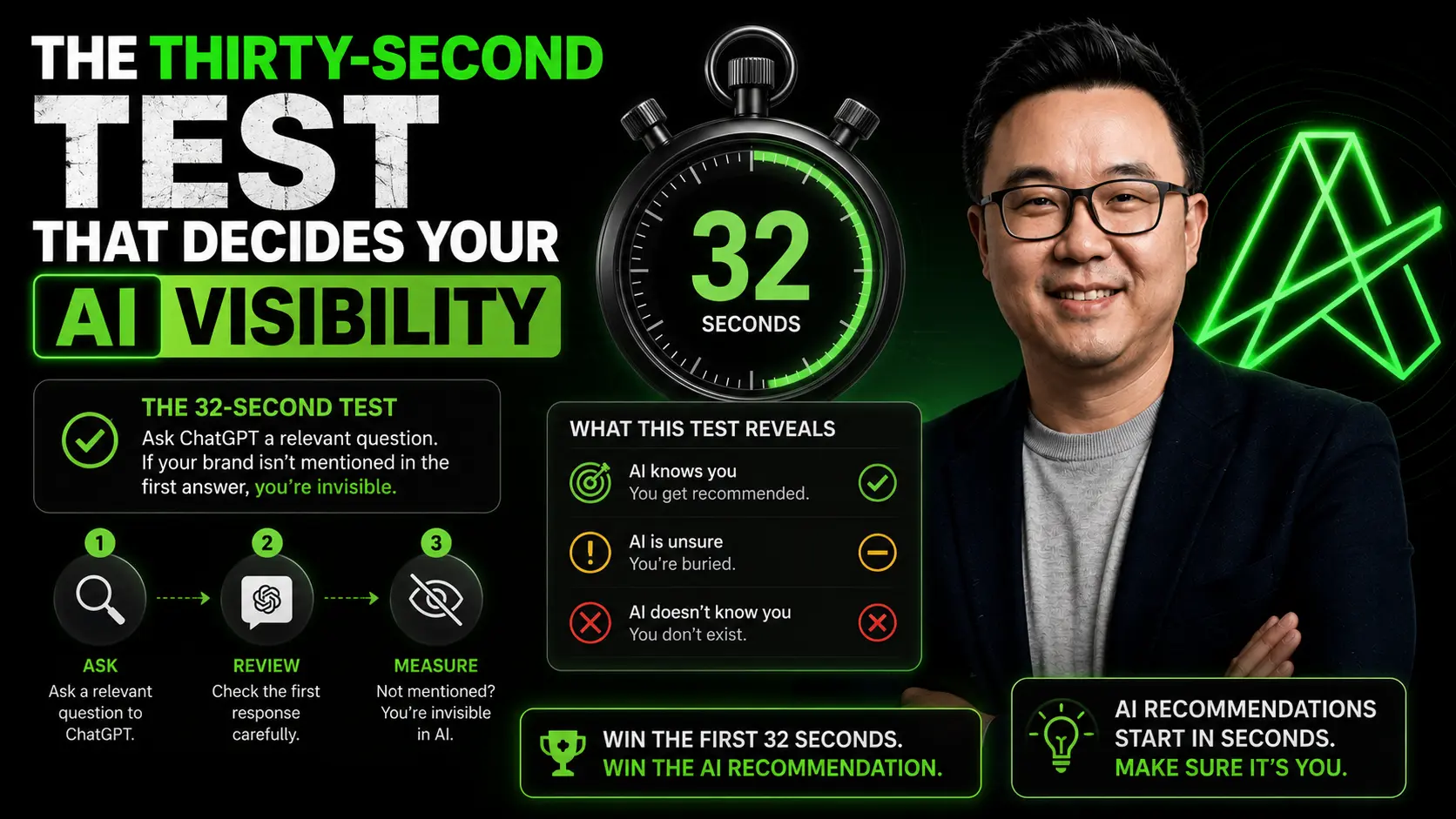
The Thirty-Second Test That Decides Your Fate
What an AI extracts from your homepage in half a minute is roughly all it will ever know about you.
AI Recommendations
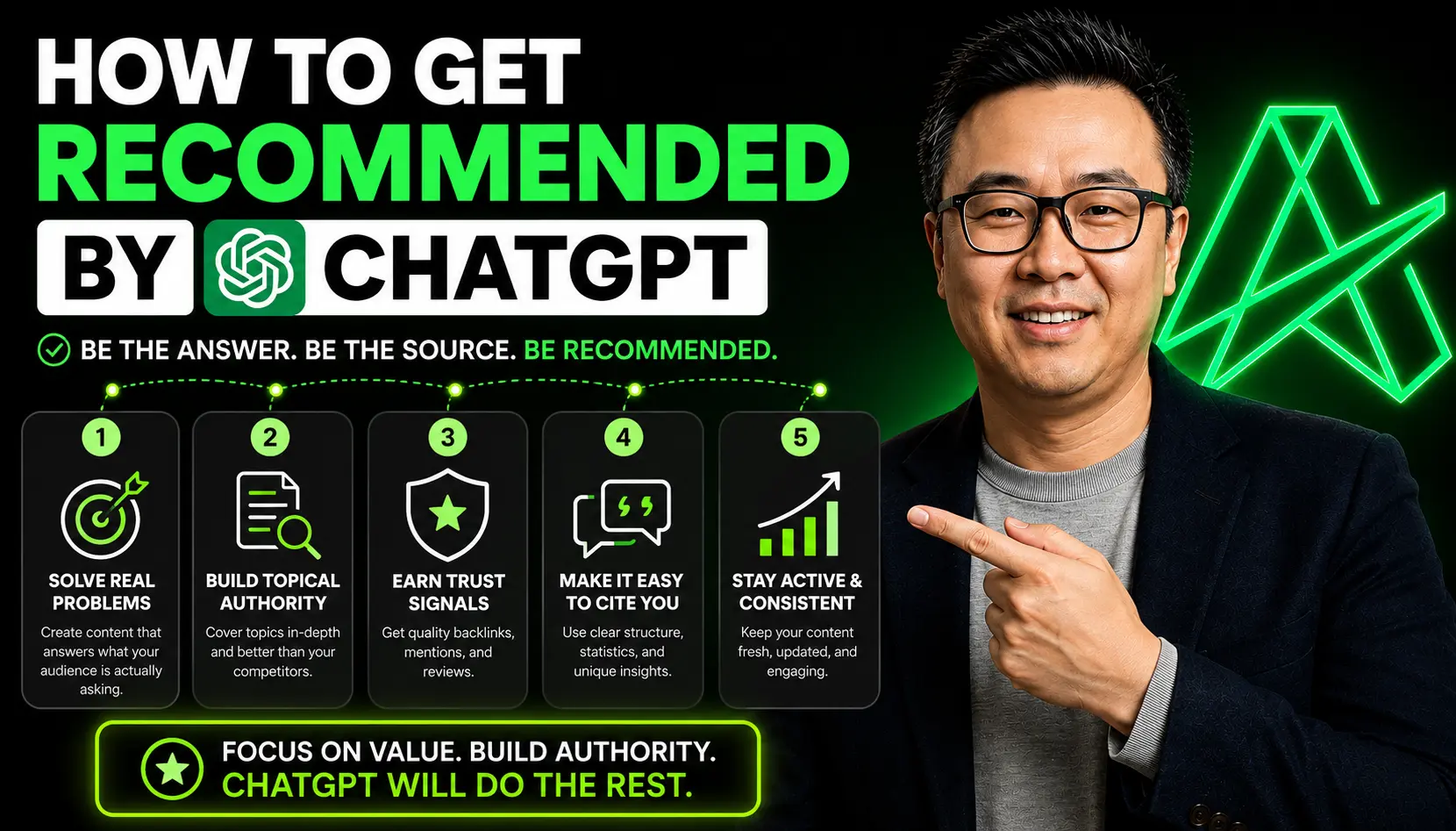
How To Get Recommended By ChatGPT
How ChatGPT actually decides which companies to name, and how founders earn a spot on the list.
See why AI recommends competitors instead of you.
AudFlo is an AI Visibility Audit Platform. Run a free scan to get your AI Visibility Score and the exact fixes that help you get recommended.
New here? Read the complete AI Visibility Guide for founders or browse every article on the blog.
About the author
Matt Lin
Architect by training. Property developer by profession. Tech entrepreneur by passion.
Founder of AudFlo, an AI Visibility Audit Platform that helps founders understand why ChatGPT recommends competitors instead of them.