
AI Visibility
The Thirty-Second Test That Decides Your Fate
What an AI extracts from your homepage in half a minute is roughly all it will ever know about you.
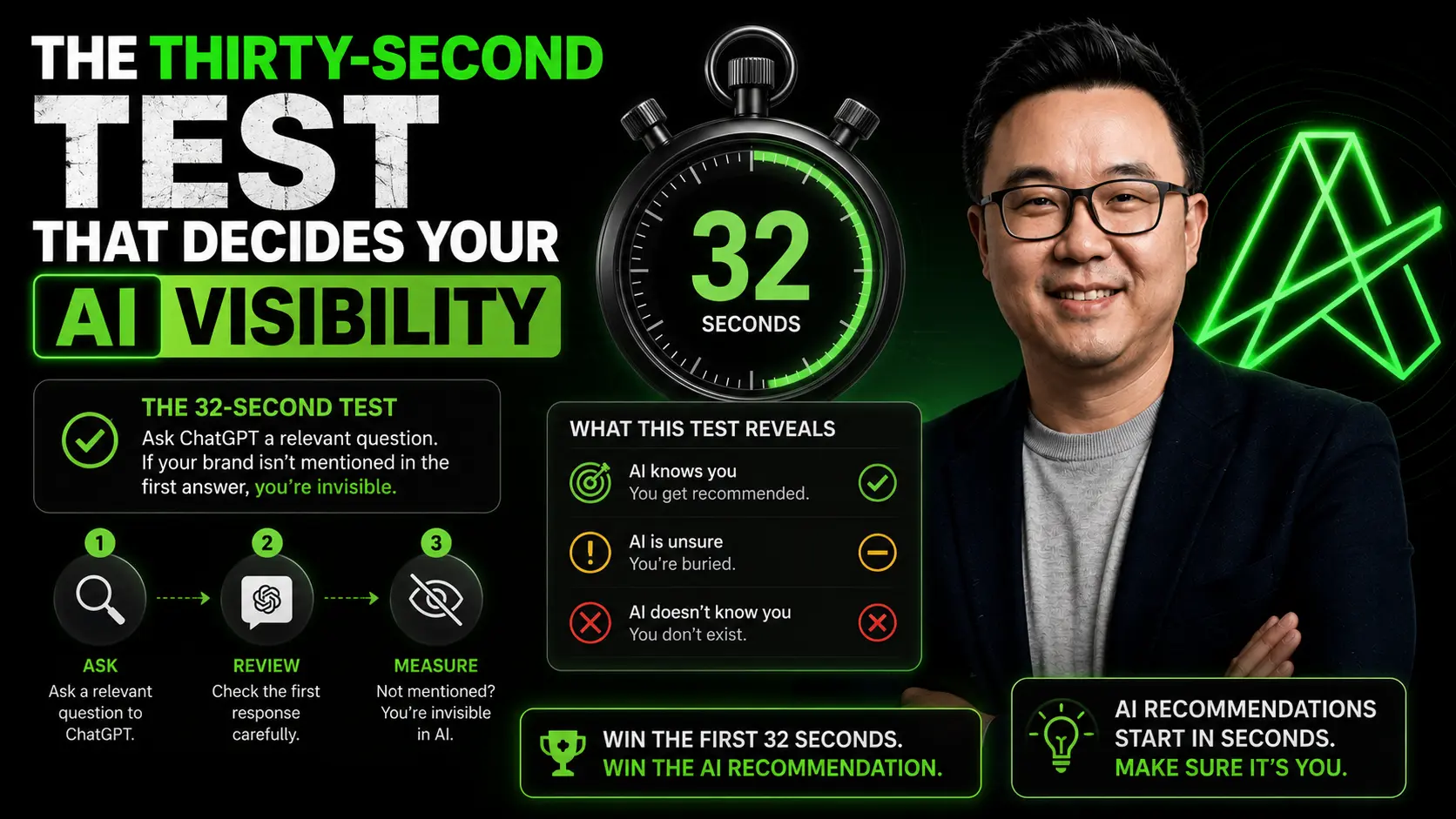
Most AI systems only spend seconds analyzing your homepage. What they find during that brief window can determine whether they recommend you or your competitors.
In this article (12 sections)
- Why AI makes decisions so quickly
- Why thirty seconds is enough
- What AI extracts from a homepage
- The 30-Second AI Visibility Test
- What this test predicts
- Why most founders fail the test
- Real homepage examples
- Run it on a competitor
- How to pass the test
- Common mistakes
- Your thirty-second checklist
- What to do next
Quick answer
AI systems do not read websites like humans. They scan key signals and form a fast understanding of what a company does, who it serves, and whether it is trustworthy. If those signals are unclear, AI engines often recommend competitors instead.
Why AI makes decisions so quickly
AI engines do not have time to study your site. They sample it. They read a little, draw a conclusion, and move on.
This is by design. The model is trying to answer a person fast, so it grabs the clearest signals and stops.
A slow, careful read would cost time the model does not have. So it optimizes for speed, and you are judged on whatever it can grab quickly.
Speed is the whole point. A buyer asked a question, and the model wants to name a good option in seconds.
That means your homepage is judged in a glance, not a deep read. The first impression is almost the entire impression.
This is true across engines. ChatGPT, Claude, Gemini, and Perplexity all work this way. Help one of them read you and you tend to help them all.
Why thirty seconds is enough
You might wonder why thirty seconds is the right window. It is roughly how long a model spends forming its first read of a page.
It does not matter if your best content sits at the bottom. The model has usually decided long before it gets there.
A human buyer behaves the same way. If your first screen is unclear, they bounce, and the model sees a page that does not explain itself.
So thirty seconds is not arbitrary. It is the window where the decision actually happens.
What AI extracts from a homepage
The model pulls a small set of signals from your page. Each one answers a question it needs in order to recommend you.
Here is what it looks for:
- Your category: what kind of product this is.
- Your buyer: who it is for.
- Your value: the problem it solves.
- Your proof: the evidence it can trust.
- Your positioning: how it would describe you to someone else.
If those signals are clear, the model can place you. If they are missing, it guesses, and a guess is rarely a recommendation.
Notice what is not on that list. Your animation, your color palette, and your clever tagline do not help the model understand you.
Think of those five signals as five questions: category, buyer, value, proof, and positioning. The test below checks each one in order, the same way an AI would.
Each signal does a job. Here is what an AI is really pulling from your first screen:
Category tells the model which question you answer. Buyer tells it who to suggest you to. Value tells it what to promise. Proof tells it whether to trust the promise. Positioning ties it together in one repeatable sentence.
This is the heart of AI visibility. For the full picture, read What Is AI Visibility? and the complete AI Visibility Guide.
The 30-Second AI Visibility Test
Here is the test. Open your homepage in a private window and read it for thirty seconds, the way an AI would.
Then answer five questions. Each one is a step. Miss a step and you fail that part of the test.
Score one point per step. Five out of five is a pass. Anything less is a gap an AI will notice.
Here are the five steps at a glance, with what a pass and a fail look like for each:
Step 1: Can AI identify your category?
Ask: what category is this company in?
You should be able to answer in a few words. Examples: an AI Visibility Platform, project management software, or a CRM.
If you cannot name the category from the first screen, you fail this step. Missing category signals are the most common reason an AI skips a founder.
Why it matters: recommendations happen by category. If the model cannot file you, you are not in the running. The full breakdown is in Missing Category Signals Is Killing Your Visibility.
Pass looks like a first line that names the category. Fail looks like a tagline that could belong to any company.
Quick fix: put the category in your first sentence and repeat it in your page title.
Step 2: Can AI identify your buyer?
Ask: who is this product for?
The answer should be specific. Examples: founders, marketing teams, or property developers.
"For everyone" is a fail. The clearer the buyer, the easier you are to recommend.
Pass looks like a named buyer in the first screen. Fail looks like a product that claims to help everyone.
Quick fix: add the buyer to your headline, for example "for founders" or "for marketing teams."
Why it matters: the model matches products to people. If it cannot tell who you serve, it cannot tell when to suggest you.
Step 3: Can AI identify your value?
Ask: what problem does this solve?
You should be able to summarize the benefit in one sentence. If you cannot, the model cannot either.
Describe the outcome in plain words. Skip the slogans and say what changes for the buyer after they use you.
Pass looks like a one-sentence outcome a stranger could repeat. Fail looks like a mood or a metaphor.
Quick fix: finish this line in plain words: after using us, customers can now ________.
Why it matters: a model cannot quote a feeling. It needs a clear, plain statement of value it can repeat.
Step 4: Can AI find proof?
Ask: what evidence is on the page?
Look for proof the model can verify:
- Testimonials with real names.
- Customer logos.
- Usage statistics.
- Short case studies.
No proof means lower trust. Trust signals directly affect whether an AI will stand behind you in an answer.
Why it matters: the model would rather name a product it can vouch for than risk one it cannot verify.
Pass looks like named customers and real numbers. Fail looks like anonymous quotes or no proof at all.
Quick fix: add three testimonials with real names, companies, and outcomes.
Step 5: Can AI repeat your positioning?
Ask: can an AI confidently finish this sentence?
"This company helps ________ do ________."
If the blanks are obvious, you pass. If the model would have to guess, you fail.
Why it matters: clear positioning is what lets a model describe you to a stranger. Weak positioning is a quiet killer, covered in Weak Brand Positioning Confuses AI Models.
Pass looks like both blanks filling themselves in from your first screen. Fail looks like a page where you would have to guess.
Quick fix: write the sentence yourself, then make sure your homepage says the same thing.
What this test predicts
This is not a vanity check. The five questions map to the exact signals an AI weighs before it recommends a company.
Pass all five and you are easy to understand and easy to trust. That is most of what it takes to be named in an answer.
Fail two or three and the model has to guess. When it guesses, it usually reaches for a competitor that scored higher on clarity.
So the test predicts something simple: how likely an AI is to put your name forward when a buyer asks for the best option.
Why most founders fail the test
Most founders fail without realizing it. They are too close to their own product to see the gaps.
A few patterns show up again and again:
- The headline is a slogan, not a category.
- The buyer is never named.
- The value is described as a feeling.
- The proof is missing or anonymous.
You know your product cold, so your brain fills in the blanks. An AI has no such context. It only sees the words on the page.
That is why the test works. It forces you to read your own page like a stranger with thirty seconds and no patience.
Real homepage examples
Picture two homepages for similar products. One passes, one fails.
The failing page leads with "Work, reimagined." There is a big animation, a short tagline, and a sign-up button. No category, no named buyer, no proof.
An AI reading that page fails every step. It cannot place the company, so it recommends someone else.
The passing page leads with one line: "A project tracker for small remote teams." Below it are three named customer quotes and a short FAQ.
An AI reading that page passes every step in seconds. Same kind of product, very different result.
Now picture a third page, heavy with features. It lists twenty things the product does, but never says the category or the buyer.
That page fails too. A pile of features is not a category, and the model still cannot tell who it is for.
The difference between pass and fail is not design talent. It is clarity.
Run it on a competitor
Once you have scored your own page, score a competitor the AI already recommends.
Read their homepage for thirty seconds and answer the same five questions. You will usually find they pass the steps you fail.
This is the fastest way to see the gap. It is not that they are better. It is that they are clearer.
Copy what works. Name your category as plainly as they do, then back it with stronger proof.
How to pass the test
You can pass this test in an afternoon. Work the five steps in order.
- Rewrite your first line to name the category and the buyer.
- State the core outcome in one plain sentence.
- Add three named customer proofs.
- Add a short FAQ that answers real buyer questions.
- Repeat the category in your title tag and meta description.
Use a simple shape for the headline: product is a category for a buyer.
Put the important words in text, not in an image. The model reads text, not pictures.
Keep the language simple. Short words and short sentences are easier for both people and models to read.
You are not writing for a search engine. You are writing for a reader who has thirty seconds, and a model that reads like one.
Then read the page again for thirty seconds. If you can answer all five questions, an AI can too.
Common mistakes
A few mistakes keep founders stuck. They are easy to make and easy to fix.
- Leading with a clever line that means nothing to an outsider.
- Hiding the category inside a paragraph instead of the first line.
- Putting the real message in an image the model cannot read.
- Listing features without naming the buyer who needs them.
- Using testimonials with no names attached.
None of these are fatal on their own. Together, they make you invisible to an AI.
Fix them one at a time. Each fix you make raises your score and your odds of being recommended.
Your thirty-second checklist
Keep this list next to your homepage. Read the page for thirty seconds, then tick each box.
What to do next
Run the test today. Be honest about which steps you fail.
Fix the failing steps, starting with your category line. Then rescan and watch your score move.
To understand the score itself, read AI Visibility Score Explained. If AI is still picking your competitors, the deeper reasons are in Why ChatGPT Recommends Your Competitors Instead of You.
Run a free AI Visibility Audit and see exactly what AI engines extract from your homepage.
Make this a habit, not a one-time fix. Run the test every month and after any homepage change.
Small edits compound. A clearer category line this week and stronger proof next week add up to a page an AI can recommend without hesitation.
Key takeaways
- →AI forms opinions quickly.
- →Your homepage is the strongest signal.
- →Category clarity matters more than clever copy.
- →Trust signals affect recommendations.
- →Most founders fail this test without realizing it.
Common questions
FAQ.
What is the 30-second AI visibility test?+
Why does homepage clarity matter so much?+
How much content does AI actually read?+
Can a good design still fail the test?+
What are category signals?+
What is AI visibility?+
How often should I run this test?+
Continue reading
More from the blog.
AI Visibility
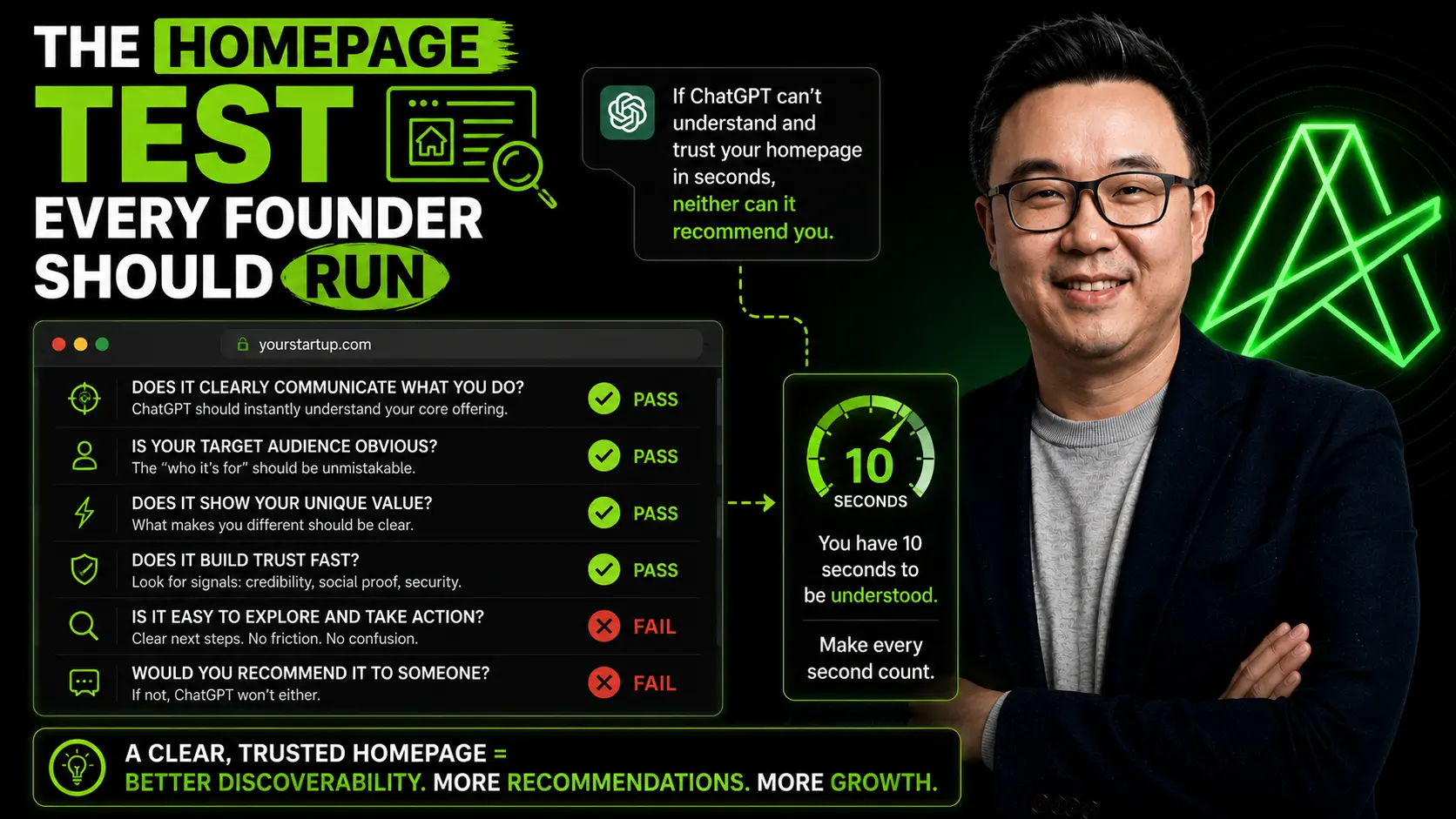
The Homepage Test Every Founder Should Run
A quick, repeatable way to score your homepage the way an AI reads it.
AI Visibility
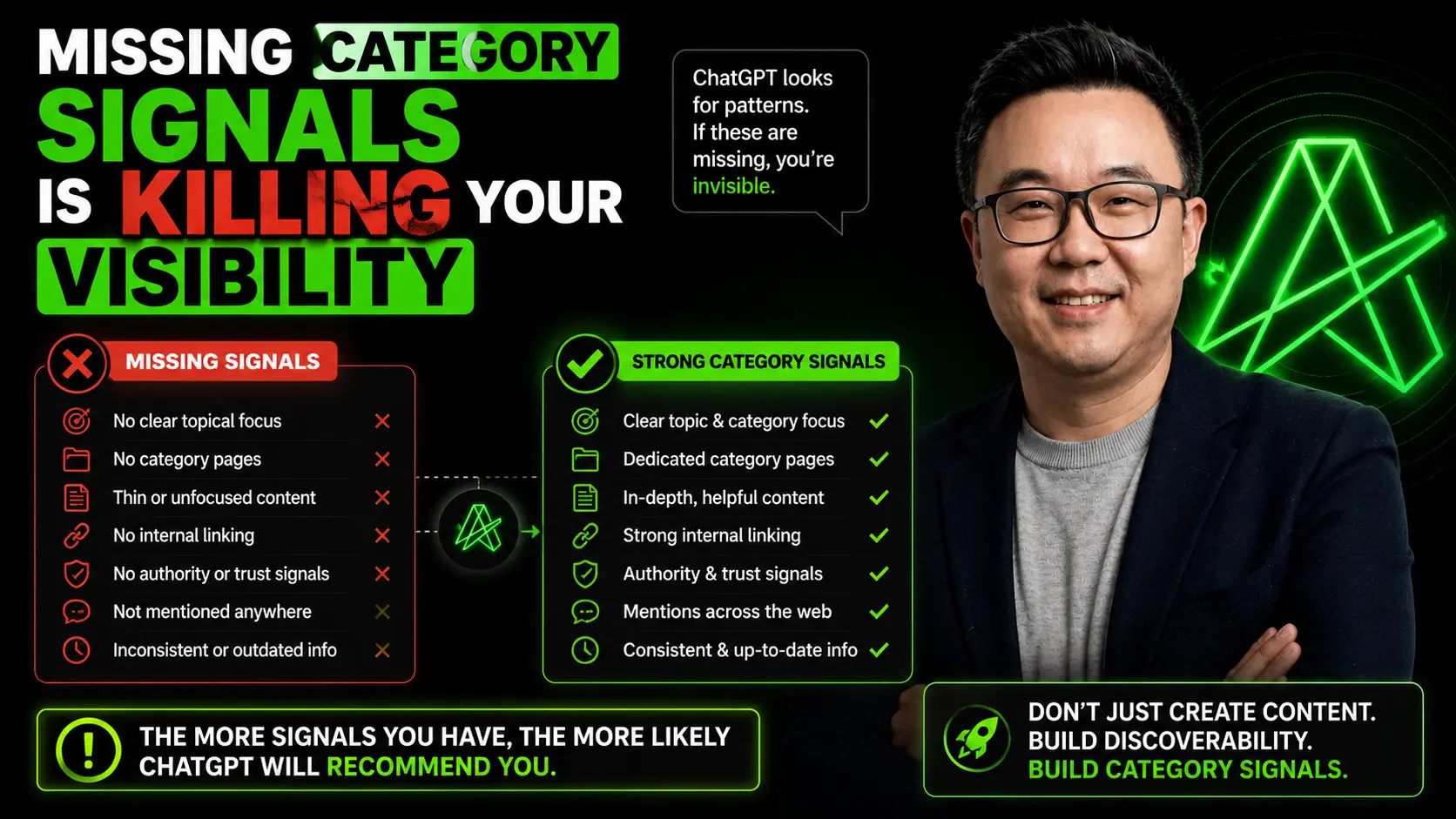
Missing Category Signals Is Killing Your Visibility
If an AI cannot tell what category you are in, it cannot recommend you. Here is how to find and fix the gap.
See why AI recommends competitors instead of you.
AudFlo is an AI Visibility Audit Platform. Run a free scan to get your AI Visibility Score and the exact fixes that help you get recommended.
New here? Read the complete AI Visibility Guide for founders or browse every article on the blog.
About the author
Matt Lin
Architect by training. Property developer by profession. Tech entrepreneur by passion.
Founder of AudFlo, an AI Visibility Audit Platform that helps founders understand why ChatGPT recommends competitors instead of them.