
AI Visibility
Getting Cited by AI Is Only Half the Job. The Other Half Is Being Trusted.
Brands now spend two days a week chasing AI visibility. But a citation leaks if the buyer cannot trace it back to a brand they trust. Visibility and trust are one job.

A citation gets you named. Trust is what survives the verification the buyer runs next.
Quick answer
Getting cited by an AI engine is only half the job because a citation almost never ends in a click, and the people who do reach you immediately go and verify what the AI said. Enterprise teams now spend about 16.6 hours a week chasing AI visibility, yet when an AI answer appears, click-through to any source drops from roughly 15% to 8%, and only about 1% of users click a source named inside the answer. The buyers who do come through run their own check: most re-search, visit your website directly, or click the cited sources, and what they find there decides whether they trust you. That makes visibility and trust a single job, not two. The same signals that make an engine cite you, a clear category line, named proof, specific numbers, a real founder, and honest comparisons, are the same signals that make a person believe you when they land. Build both on one page and the citation finally pays off.
The short version
Brands are pouring real time into getting named by AI engines. The average enterprise team now spends about two working days a week on AI visibility. The instinct is right: the engines decide more of the shortlist every month. But most of that effort is aimed at a goal nobody has defined, and a lot of it leaks before it reaches a customer.
Here is the leak. A citation in an AI answer reaches a buyer in under a second, and then almost nothing happens, because the answer already satisfied them in place. The few who do come looking immediately go and verify what the AI told them. What they find on your site, not the citation, is what decides whether you win them.
That is why being cited is only half the job. The other half is being the kind of brand a person trusts the moment they land. Those two halves are not separate workstreams. They get decided on the same page, which makes them one job.
The hours are going somewhere
AI discoverability went from a curiosity to a standing budget line in under two years. It is now a top-three priority at most enterprises, and the hours show it. What has not caught up is the internal definition of winning. Most teams are spending against a number nobody has agreed on.
You can track AI referral traffic and conversions the way you track any attributed channel. Or you can keep reporting activity and hope no one asks what it earned. The first step out of that trap is knowing what AI visibility actually is, which is the whole point of what AI visibility means for a brand your size.
A citation is not a click
The uncomfortable part of the data is how little a citation moves on its own. When an AI answer appears above the results, people click less, not more, because the answer is the destination now.
A mention is not a visit, and a visit is not yet trust. If your entire AI strategy is built on appearing in the answer, you are optimizing the cheapest, leakiest part of the funnel. The value is not in being named. It is in what happens when a buyer decides to look closer, which most of them do on their own terms, not by clicking the tidy link the AI offered.
They leave to check you out
People do not take an AI answer as final. They treat it as a starting point and then run their own check, and this is true even of the people who say they trust AI.
This is the moment that matters. The buyer has heard your name from a machine and now wants to confirm it from a source they trust more: a fresh search, your own website, the cited page. If what they find is thin, generic, or impossible to place, the citation you worked for evaporates. This is the same penalty weak, generic positioning has always carried, except now the verification step is built into how people buy.
Why the split loses
Most teams cannot win the verify loop because the work was cut in half two years ago, before anyone knew it was one job. Visibility went to whoever owned SEO. Trust stayed with whoever owned brand and content. Two teams, two scoreboards, one customer caught in between.
The split feels organized and it quietly loses. The visibility team celebrates a citation the trust team cannot cash, because the page the engine points to was never built to convince a skeptical human. Meanwhile the brand team polishes a story the engine cannot parse, classify, or cite. Each team hits its own number while the customer slips through the gap.
Visibility and trust are one job
The brands closing that gap stopped treating it as two problems. They rebuilt around the one place both jobs actually get done: the website. It is where an AI engine extracts and cites you cleanly, and it is where a person lands to decide whether you are worth choosing. The same page has to answer both.
A citation in an AI answer is close to worthless if the buyer cannot trace it back to a brand they trust. Being visible is not enough. The website is where you provide the context and earn the trust.
That is the core of what AI visibility really is: not a ranking trick, but a single foundation that serves the machine reading you and the human it sends.
The signals that do both
Here is the part that makes the one-job framing practical instead of abstract. The signals that earn you a citation are, almost exactly, the signals that earn a buyer's trust. You do not have to choose. You ship them once and both readers get what they need.
A clear category line tells the model how to classify you and tells a stranger what you are. Named proof is a trust signal an engine can weigh and evidence a buyer believes. Specific numbers are checkable to a machine and concrete to a person. An honest comparison page gives the engine a tradeoff to quote and the buyer a real decision aid. An answer-first FAQ hands the engine clean pairs to lift and the reader fast answers. These map directly onto the four pillars the AI Visibility Score measures. Generic AI content has none of them, which is exactly why it is everywhere and still not winning.
What to do this week
You do not need a rebuild. You need a handful of real signals on the page, stated plainly enough for both readers.
Start by reading your homepage cold, the way the 30-second test asks you to: could a person and an AI both say what you are from the first screen? Then add the proof a buyer checks for in the verify loop, a named testimonial, a specific number, a real founder line, and keep the page answer-first so an engine can still read it. Then run a scan to see where an engine places you today and what to fix next.
The takeaway
The hours teams are spending on AI visibility are not wasted, but most are aimed at half the problem. Getting named by an engine is real, and it is cheap, and it leaks unless the brand behind the name holds up when a buyer goes to check. By next budget cycle, the teams who connected the citation to the trusted experience will have numbers to defend. Everyone else will be re-litigating their AI strategy in meetings.
Visibility and trust stopped being separate goals the moment AI made verification a reflex. Build for both on the same page, and the citation finally turns into a customer. For the full method, read the complete AI Visibility Guide or see a real sample audit.
- 16.6 hrs/week on AI visibility; 74% rank it a priority; 60% find AI in messaging a turnoff; 86% check the source ·WordPress VIP Future of the Web (2026)
- Click-through falls from 15% to 8% when an AI answer appears; 1% click cited sources ·Pew Research Center (2025)
- Even AI-trusting consumers verify: 62% re-search, 58% visit the brand site, 52% click sources ·Yext Consumer Search Behaviors Report (2026)
- Trust now ranks alongside price and quality as a purchase driver ·Edelman Trust Barometer, Brand Trust (2025)
- AudFlo methodology: the four pillars and 32 checks
Key takeaways
- →Enterprise teams spend about 16.6 hours a week on AI visibility, often with no shared definition of winning.
- →When an AI answer appears, click-through to sources falls from about 15% to 8%, and only ~1% click the cited source.
- →Even consumers who trust AI verify it: most re-search, visit the brand site, or click the sources.
- →A citation leaks if the buyer cannot trace it back to a brand they recognize and trust.
- →Visibility and trust are one job because both get decided on the same page: your website.
- →The signals that earn the citation (clear claim, named proof, specifics, founder, comparisons) are the same ones that earn the trust.
Common questions
FAQ.
Is being cited by an AI engine enough to win the customer?+
Why do so few people click the sources in an AI answer?+
What is the relationship between AI visibility and brand trust?+
How do I make my site work for both AI engines and people?+
What should I measure instead of impressions in AI answers?+
Continue reading
More from the blog.

AI Visibility
The Web Feels Less Human. What That Means for Getting Recommended.
The web is now mostly machine-written, and people can tell. The brands that feel human, and stay machine-readable, are the ones AI recommends.
AI Visibility
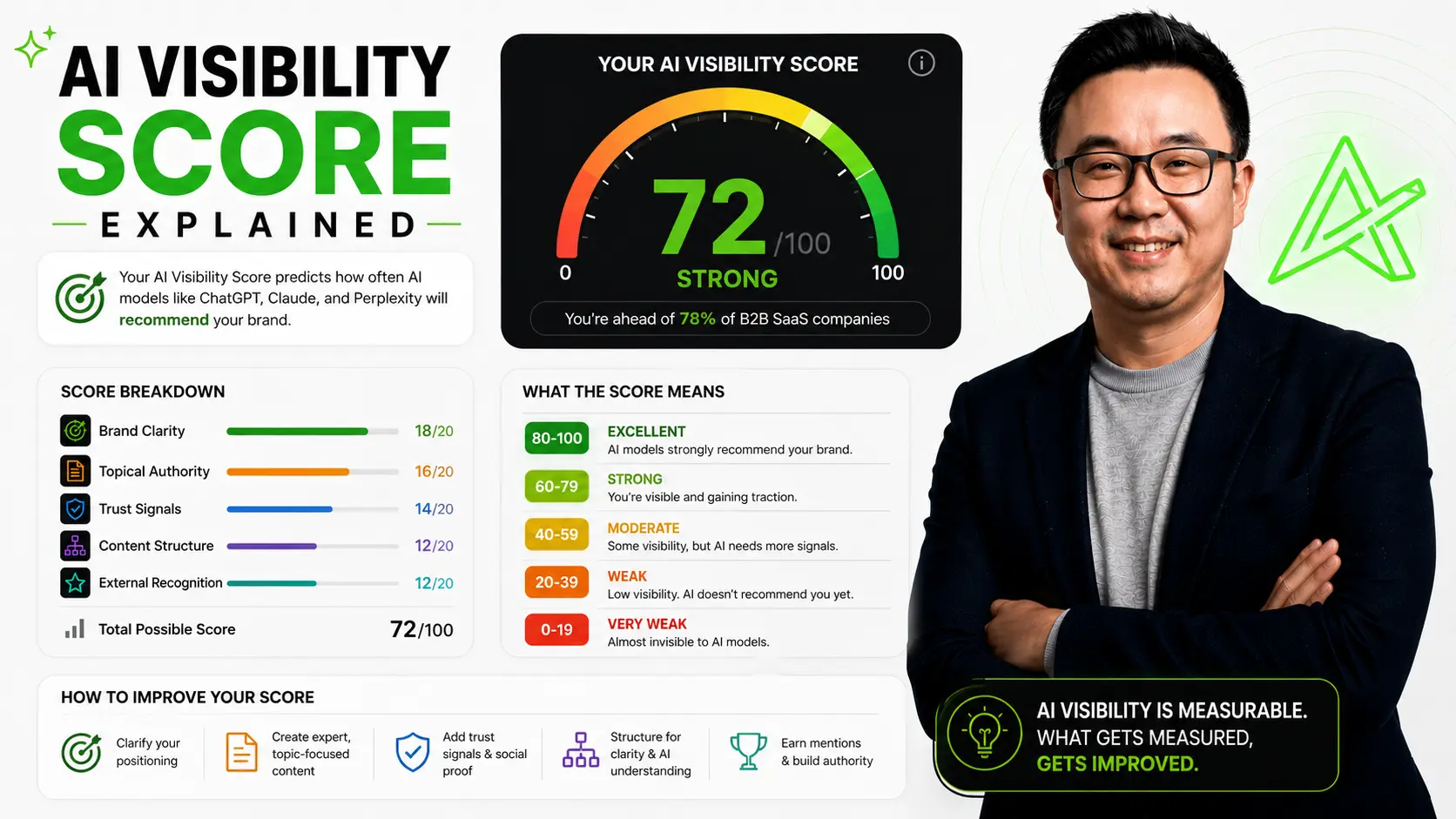
AI Visibility Score Explained
What the number means, how it is built from four weighted pillars, and how to move it up over time.
See why AI recommends competitors instead of you.
AudFlo is an AI Visibility Audit Platform. Run a free scan to get your AI Visibility Score and the exact fixes that help you get recommended.
New here? Read the complete AI Visibility Guide for founders or browse every article on the blog.
About the author
Matt Lin
Architect by training. Property developer by profession. Tech entrepreneur by passion.
Founder of AudFlo, an AI Visibility Audit Platform that helps founders understand why ChatGPT recommends competitors instead of them.