
AI Visibility
The Web Feels Less Human. What That Means for Getting Recommended.
The web is now mostly machine-written, and people can tell. The brands that feel human, and stay machine-readable, are the ones AI recommends.

The web is mostly machine-written now. Feeling human is how you get trusted, and recommended.
Quick answer
The web feels less human because it largely is: by 2025, more than half of new web articles were AI-generated, and surveys show most people now distrust obvious AI in search and brand messaging. For founders, the instinct is to either flood the web with more AI content or hide from AI engines entirely, and both lose. Your site now has two readers at once: the AI engines that build the shortlist, and the humans they send to you. The good news is that the signals that make you feel human, a real founder, named proof, specific numbers, and honest comparisons, are the same signals AI engines trust when they decide whom to recommend. Be clear and machine-readable, and unmistakably human, on the same page.
The short version
The web feels less human because it largely is. By 2025, more than half of all new web articles were being written by AI, and people can feel the shift even when they cannot name it. The internet they grew up trusting now reads like it was assembled by a machine, because more and more of it was.
For a founder, that creates a strange double bind. The same AI engines flooding the web with content are also the engines that now decide which brands get recommended. You cannot ignore them, and you cannot out-volume them.
The way through is not louder content or a retreat from AI. It is to be the rare thing the synthetic web is short on: a brand that is clear enough for a machine to cite and human enough for a person to trust. Those two goals sound like a tradeoff. They are actually the same job.
The web is now half machine
Start with the scale of it. Before ChatGPT, roughly one in ten new web articles was AI-generated. By 2024 it was around 40 percent. By 2025 it crossed half. The median page a buyer scrolls past is now as likely to be machine-written as not.
That is the root cause of the feeling. When most of what you read is generated, the texture of the web changes: the same phrasings, the same hollow confidence, the same pages that say a lot and mean little. It is why 74 percent of people now say the internet feels less human than it did a decade ago.
But notice the counterweight in the data. Even with AI producing half of all new content, the pages that actually rank and get cited are still overwhelmingly human-led. Volume went up. Trust did not follow it. That gap is the opening.
And people can tell
The instinct that the web feels off is not vague. People are getting good at spotting synthetic content, and they punish it.
More than half of consumers distrust AI-powered search results outright, and a large share find AI summaries more frustrating than the old way. Put obvious AI in your marketing and a meaningful slice of buyers will like you less for it. This is the same dynamic weak, generic positioning has always created, only now it is amplified, because the bar for "sounds like everyone else" has dropped to the floor.
None of this means people hate AI. Most accept it when it is used well and the result is genuinely useful. What they reject is the tell: content with no real proof, no point of view, and no person behind it.
The trap founders fall into
Faced with a synthetic web, founders tend to make one of two moves. Both feel reasonable. Both lose.
The first is to fight volume with volume: spin up dozens of AI-written pages to blanket every keyword. It adds to the exact slop people already distrust, and it gives an engine no reason to single you out. The second is to recoil from AI entirely, treating engines as a threat to wait out. That just makes you invisible to the systems now assembling the shortlist before a human ever lands on your site. To understand why that shortlist matters so much, see how ChatGPT decides what to recommend.
The brands worth watching are doing neither. They treat AI as a reader to serve and a channel to earn, while keeping the page worth a human's time.
You have two readers now
Here is the shift in one sentence: your website used to have one audience, and now it has two. An AI engine reads your page to decide whether to cite you. A human reads it after the engine sends them, to decide whether to stay.
These two readers want things that look different on the surface. The machine wants structure, clarity, and signals it can parse. The person wants a reason to believe you and a reason not to bounce. Most founders optimize for one and forget the other. They either build a beautiful site an AI cannot classify, or a technically clean site with nothing on it a person would trust. The website is the one place both jobs have to run together, which is the whole argument behind what AI visibility is.
Sounding human is being recommendable
This is the part that resolves the tension. The signals that make your page feel human are, almost exactly, the signals an AI engine uses to decide whether to trust and recommend you. They do double duty.
A real founder and team reads as human to a person and as a verifiable entity to a model. Named testimonials feel like proof to a buyer and count as a trust signal to an engine. Specific numbers sound honest to a reader and are checkable to a machine. An honest comparison page helps a person decide and gives an engine the tradeoff it can quote. A clear category line tells a stranger what you are and tells the model how to classify you. An answer-first FAQ gives the reader quick answers and the engine clean pairs to lift.
So the move is not to choose between human and machine-readable. It is to ship the handful of signals that satisfy both, which is exactly what the four pillars in the AI Visibility Score measure. Generic AI content has none of them. That is why it is everywhere and still not winning.
What to do this week
You do not need a redesign. You need a few real signals on the page, stated plainly enough for both readers.
Start by reading your homepage cold, the way the 30-second test asks you to: could a person and an AI both say what you are from the first screen? Then add one genuinely human signal, a founder line, a named testimonial, a specific number, and make sure the page stays clean and answer-first so an engine can still read it. Then run a scan to see where an AI engine places you today and what to fix next.
The takeaway
The synthetic web is not a reason to panic, and it is not a reason to add to it. It is the clearest opening founders have had in years. As content gets cheaper and more uniform, the things that cannot be faked at scale, a real person, real proof, a clear and honest claim, become the things that stand out to people and to the models that recommend them.
Feeling human and being recommendable stopped being separate goals. Build for both on the same page, and you win the reader the machine sends you. For the full method, read the complete AI Visibility Guide or see a real sample audit.
- 52% of new web articles are AI-generated ·Graphite (2025)
- 53% distrust AI-powered search results ·Gartner (2025)
- 74% say the internet feels less human; bot fatigue at ~40 min ·WordPress VIP Future of the Web (2026)
- 73% can spot and reject AI-generated marketing ·SmythOS (2025)
- AI in ads lowers brand choice and intent ·eMarketer / Nuremberg Institute (2025)
- AudFlo methodology: the four pillars and 32 checks
Key takeaways
- →Over half of new web articles are now AI-generated, and people feel it.
- →74% say the internet feels less human; most distrust obvious AI in search and messaging.
- →Flooding the web with AI content and hiding from AI are both losing moves.
- →Your site now has two readers: AI engines and the humans they send.
- →The signals that feel human (a real founder, named proof, specifics) are the same ones AI trusts.
- →Be clear and machine-readable, and unmistakably human, on the same page.
Common questions
FAQ.
Why does the web feel less human now?+
Should I stop using AI to write my content?+
Does sounding human hurt my AI visibility?+
What is AI brand visibility?+
How do I check if my site reads as human and machine-readable?+
Continue reading
More from the blog.

AI Visibility
Getting Cited by AI Is Only Half the Job. The Other Half Is Being Trusted.
Brands now spend two days a week chasing AI visibility. But a citation leaks if the buyer cannot trace it back to a brand they trust. Visibility and trust are one job.
AI Visibility
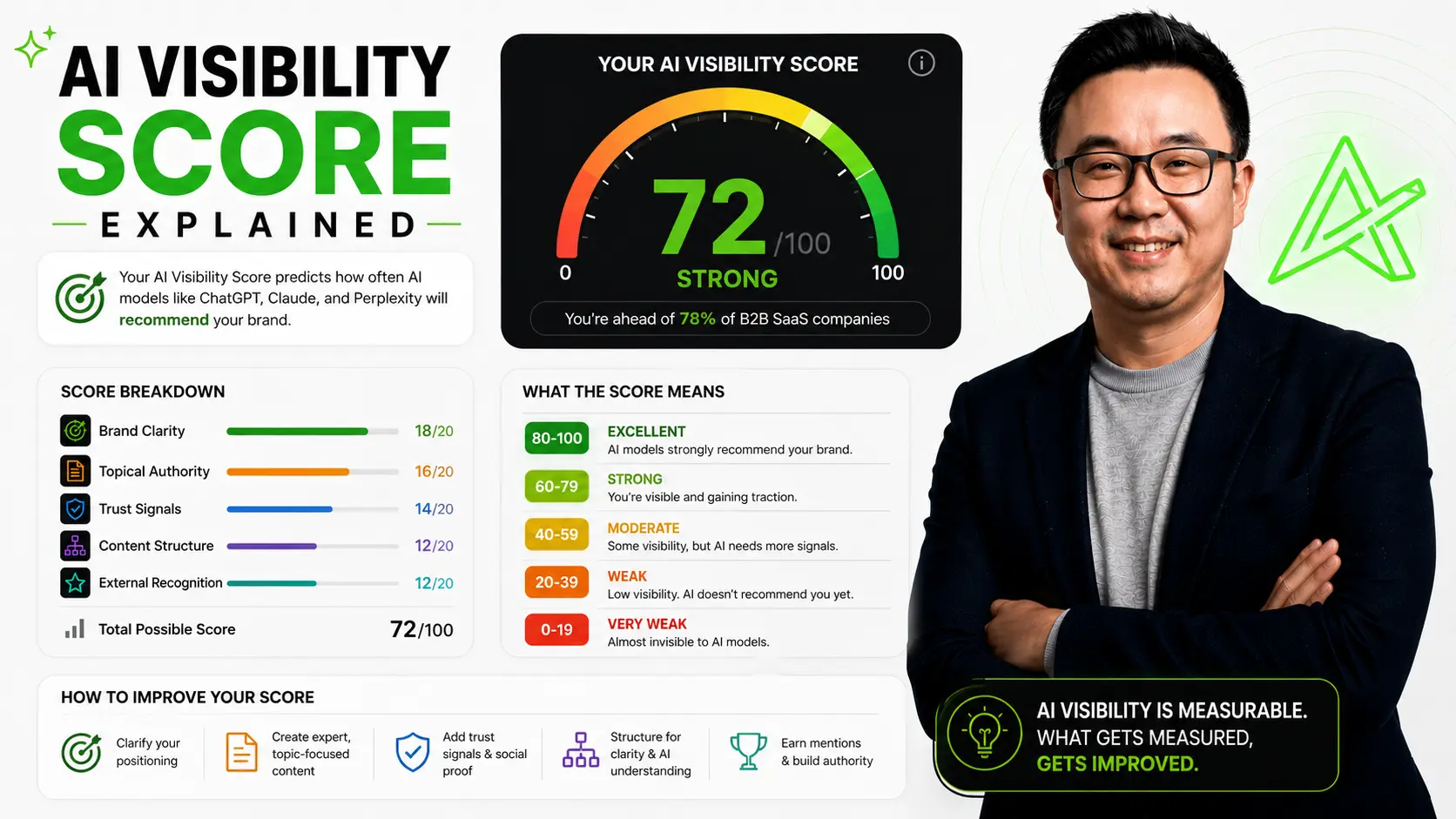
AI Visibility Score Explained
What the number means, how it is built from four weighted pillars, and how to move it up over time.
See why AI recommends competitors instead of you.
AudFlo is an AI Visibility Audit Platform. Run a free scan to get your AI Visibility Score and the exact fixes that help you get recommended.
New here? Read the complete AI Visibility Guide for founders or browse every article on the blog.
About the author
Matt Lin
Architect by training. Property developer by profession. Tech entrepreneur by passion.
Founder of AudFlo, an AI Visibility Audit Platform that helps founders understand why ChatGPT recommends competitors instead of them.